



The Results of Phase III OptiTROP-Lung05 Study of Sacituzumab Tirumotecan (sac-TMT) Presented as an ASCO Oral Presentation and Simultaneously Published in The Lancet
The Results of Phase III OptiTROP-Lung05 Study of Sacituzumab Tirumotecan (sac-TMT) Presented as an ASCO Oral Presentation and Simultaneously Published in The Lancet |
| [29-May-2026] |
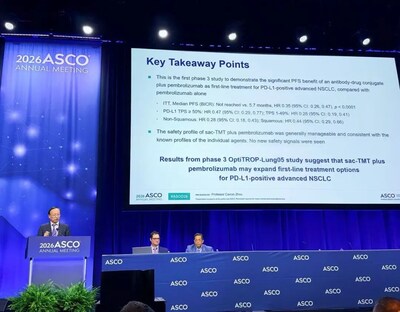
CHENGDU, China, May 29, 2026 /PRNewswire/ -- Sichuan Kelun-Biotech Biopharmaceutical Co., Ltd. (the "Company", 6990.HK) announced today that at the 2026 American Society of Clinical Oncology (ASCO) Annual Meeting in Chicago, the results of the Phase III clinical study OptiTROP-Lung05, evaluating the company's TROP2 ADC sacituzumab tirumotecan (sac-TMT, also known as SKB264/MK-2870)(佳泰莱®) in combination with pembrolizumab (KEYTRUDA®[1], MSD's anti-programmed cell death protein 1 (PD-1) antibody) as first-line treatment for Programmed Death-Ligand 1 (PD-L1) Tumor Proportion Score (TPS)≥1% non-small cell lung cancer (NSCLC), was presented as an oral presentation by Professor Caicun Zhou from Shanghai East Hospital, Tongji University (Abstract #8506, Lung Cancer – Metastatic Non-Small Cell).
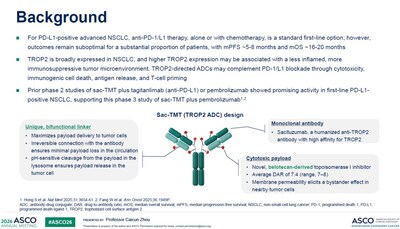
Sac-TMT is designed with a unique, bifunctional linker and differentiated belotecan-derivative payload. The linker is conjugated via cysteine, which maximizes payload delivery to tumor cells both through its irreversible connection with the high-affinity and targeting anti-TROP2 monoclonal antibody sacituzumab and its pH-sensitive cleavage from a moderately toxic novel topoisomerase I inhibitor payload in the lysosome, with a drug-to-antibody-ratio (DAR) of 7.4.
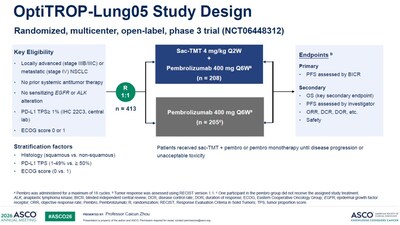
In the OptiTROP-Lung05 study, a total of 413 patients were randomized (1:1) to receive either sac-TMT in combination with pembrolizumab or pembrolizumab monotherapy.
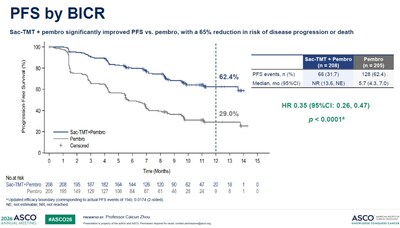
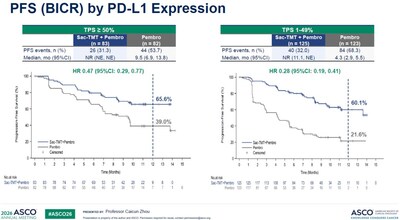
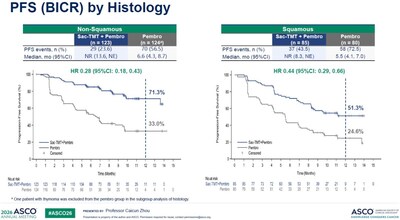
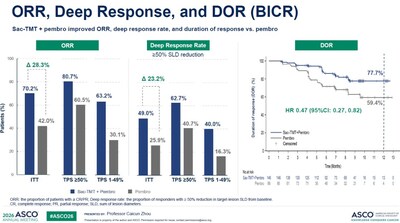
As of the data cutoff date (September 29, 2025), with a median follow‑up of 10.5 months, the study demonstrated that:
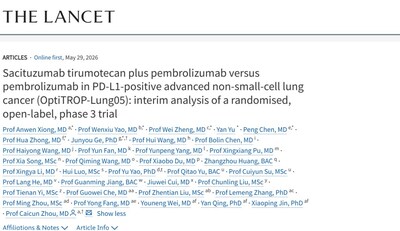
The incidence of grade ≥3 treatment-emergent adverse events (TEAEs) was higher in the combination group, primarily driven by the expected hematologic adverse events of sac-TMT. Incidence of discontinuation of pembrolizumab due to TEAEs was similar in both groups. No sac-TMT-related deaths occurred. Adverse events of special interest (AEOSIs) were consistent with the known safety profiles of each individual agent, and no new safety signals were identified. The interim analysis results show that sac-TMT plus pembrolizumab significantly prolonged PFS and reduced the risk of disease progression or death compared with pembrolizumab alone, with consistent PFS benefits observed across all prespecified subgroups (including PD‑L1 expression levels and histological subtypes). A positive trend in OS was also observed. Furthermore, the overall safety profile of sac-TMT in combination with pembrolizumab was manageable, consistent with the established safety profiles of sac-TMT alone or pembrolizumab alone. Notably, the findings of OptiTROP-Lung05 have been simultaneously published in The Lancet(Impact Factor=88.5), indicating that its clinical and academic value has received dual recognition from a leading international academic conference and an authoritative journal.
Professor Caicun Zhou, the national leading principal investigator from Shanghai East Hospital, Tongji University, said: "The positive results of the OptiTROP‑Lung05 study are encouraging. The study not only supports the application of sac‑TMT in an earlier-line setting for lung cancer, but also provides evidence of the 'ADC+IO' synergistic strategy being evaluated in the first-line setting for PD‑L1‑positive advanced NSCLC, potentially bringing a new option to a broad population of patients with lung cancer."
About sac-TMT(佳泰莱®) Sac-TMT, a core product of the Company, is a novel human TROP2 ADC in which the Company has proprietary intellectual property rights, targeting advanced solid tumors such as NSCLC, breast cancer (BC), gastric cancer (GC), gynecological tumors and genitourinary tumors, among others. Sac-TMT is developed with a unique, bifunctional linker that maximizes payload delivery to tumor cells both through its irreversible connection with the anti-TROP2 monoclonal antibody sacituzumab and its pH-sensitive cleavage from a belotecan-derivative topoisomerase I inhibitor payload in the lysosome, with a drug-to-antibody-ratio (DAR) of 7.4. Sac-TMT specifically recognizes TROP2 on the surface of tumor cells by recombinant anti-TROP2 humanized monoclonal antibodies, which is then endocytosed by tumor cells and releases the payload KL610023 intracellularly. KL610023, as a topoisomerase I inhibitor, induces DNA damage to tumor cells, which in turn leads to cell-cycle arrest and apoptosis. In addition, it also releases KL610023 in the tumor microenvironment. Given that KL610023 is membrane permeable, it can enable a bystander effect, or in other words kill adjacent tumor cells. In May 2022, the Company licensed the exclusive rights to MSD (the tradename of Merck & Co., Inc, Rahway, NJ, USA) to develop, use, manufacture and commercialize sac-TMT in all territories outside of Greater China (which includes Mainland China, Hong Kong, Macao and Taiwan). To date, four indications for sac-TMT have been approved and marketed in China for: 1) unresectable locally advanced or metastatic triple‑negative breast cancer (TNBC) who have received at least two prior systemic therapies (at least one of them for advanced or metastatic setting); 2) EGFR mutant-positive locally advanced or metastatic non-squamous NSCLC following progression on epidermal growth factor receptor tyrosine kinase inhibitor (EGFR-TKI) therapy and platinum-based chemotherapy; 3) epidermal growth factor receptor (EGFR) mutant-positive locally advanced or metastatic non-squamous NSCLC who progressed after treatment with EGFR-TKI therapy; 4) unresectable or metastatic hormone receptor-positive (HR+)/human epidermal growth factor receptor 2-negative (HER2-) (Immunohistochemistry (IHC) 0, IHC 1+ or IHC 2+/In Situ Hybridization (ISH)-) BC who have received prior endocrine therapy and at least one line of chemotherapy in advanced setting. The first two indications above have been included in China's National Reimbursement Drug List (NRDL). This inclusion is expected to bring clinically meaningful benefits to a greater number of patients with BC and NSCLC. Additionally, sac-TMT has been granted six Breakthrough Therapy Designations (BTDs) by the National Medical Products Administration (NMPA). Sac-TMT is the world's first TROP2 ADC drug approved for marketing in lung cancer. A new indication application for sac-TMT in combination with pembrolizumab (KEYTRUDA®) as first‑line treatment for locally advanced or metastatic NSCLC who have PD-L1 TPS≥1% and are EGFR-negative and anaplastic lymphoma kinase (ALK)-negative has been accepted for review by the NMPA, and has entered the priority review and approval process. As of today, Kelun-Biotech has initiated 9 registrational clinical studies in China. MSD is evaluating 17 ongoing global Phase III clinical studies of sac-TMT as a monotherapy or in combination with pembrolizumab or other anti-cancer agents for several types of cancer. These studies are sponsored and led by MSD. About Kelun-Biotech Kelun-Biotech (6990.HK) is a holding subsidiary of Kelun Pharmaceutical, which focuses on the R&D, manufacturing, commercialization and global collaboration of innovative biological drugs and small molecule drugs. Kelun-Biotech focuses on major disease areas such as solid tumors, autoimmune, and metabolic diseases, and in establishing a globalized drug development and industrialization platform to address the unmet medical needs in China and the rest of world. Kelun-Biotech is committed to becoming a leading global enterprise in the field of innovative drugs. At present, Kelun-Biotech has more than 30 ongoing key innovative drug projects, of which 4 projects with 8 indications have been approved for marketing, 1 project is in the NDA stage and more than 10 projects are in the clinical stage. Kelun-Biotech has established one of the world's leading proprietary ADC and novel DC platforms, OptiDC™, and has 2 ADC projects with 5 indications approved for marketing, and multiple ADC and novel DC assets in clinical or preclinical research stage. For more information, please visit https://en.kelun-biotech.com/.
SOURCE Kelun-Biotech | ||||
Company Codes: HongKong:6990 |

 View original content to download multimedia: