



Great Pacific Gold Provides Wild Dog Drilling Update: Kavasuki KVH-03 Completed Following Up KVH-01 58.9 m @ 2.50 g/t AuEq; Kasie Ridge Drilling Intersects Hydrothermal Veining with Visible Chalcopyrite
(2.50 g/t AuEq = 2.43 g/t Au, 2.75 g/t Ag, 0.02% Cu - see notes at end of release)
Vancouver, British Columbia--(Newsfile Corp. - March 11, 2026) - Great Pacific Gold Corp. (TSXV: GPAC) (OTCQX: GPGCF) (FSE: 0B3) ("Great Pacific Gold," "GPAC," or the "Company") is pleased to provide an update on ongoing exploration drilling from its Wild Dog Project, located in East New Britain Province, Papua New Guinea.
Two drill rigs are currently active at Wild Dog. Drilling continues at the Kavasuki epithermal gold vein system, while a second rig is conducting the first-ever drill test of the Kasie Ridge copper-gold target along the 15 km Wild Dog Structural Corridor (Figure 1).
Kavasuki Highlights:
- KVH-01 intersected 58.9 metres @ 2.50 g/t AuEq from 38.6m (2.43 g/t Au, 2.75 g/t Ag, 0.02% Cu),
- including 4.6 metres @ 8.56 g/t AuEq from 49.0 m (8.24 g/t Au, 10.19 g/t Ag, 0.13% Cu)
- And 18.1 metres @ 2.14 g/t AuEq from 100.6 m (2.08 g/t Au, 1.60 g/t Ag, 0.03% Cu)
(See news release March 3, 2026, for more information) - KVH-03completed and intersected strong silica flooding and multi-phase quartz veining from approximately 5 m to 51 m downhole
Kasie Ridge Highlights:
- KAS-01 drilling has intersected hydrothermally altered bedrock beneath the advanced argillic lithocap
- Strong propylitic alteration with visible chalcopyrite and hydrothermal veining encountered from approximately 50 m depth
- Portable XRF readings support visual identification of chalcopyrite within vein material (laboratory assays pending)
"Drilling continues to advance at Kavasuki following the strong initial result from KVH-01, which returned 58.9 metres at 2.5 g/t AuEq near surface," said Callum Spink, Vice President Exploration. "Drill hole KVH-03 has now been completed, and geological logging confirms strong silica flooding and multi-phase quartz veining consistent with the mineralized system we are targeting. With this hole complete, drilling has now progressed to KVH-04 as we continue testing the geometry and continuity of the Kavasuki vein system.
"At the same time, our first drill hole at Kasie Ridge has now penetrated beneath the advanced argillic lithocap and intersected strong propylitic alteration with visible chalcopyrite. While still very early in the hole, observations to date indicate hydrothermal alteration beneath the lithocap which is considered encouraging in the context of the Company's exploration model. We are excited to continue advancing this hole to depth to properly test the target, and we look forward to providing further updates as drilling progresses and assays are received."
The Wild Dog Project hosts a 15-kilometre-long structurally controlled mineral corridor containing multiple epithermal gold targets and porphyry copper-gold potential identified through recent MobileMT geophysical surveys.
The corridor contains the Sinivit-Kavasuki vein system and multiple advanced targets including Kasie Ridge, which are now being systematically drill tested as part of the Company's 2026 exploration program.
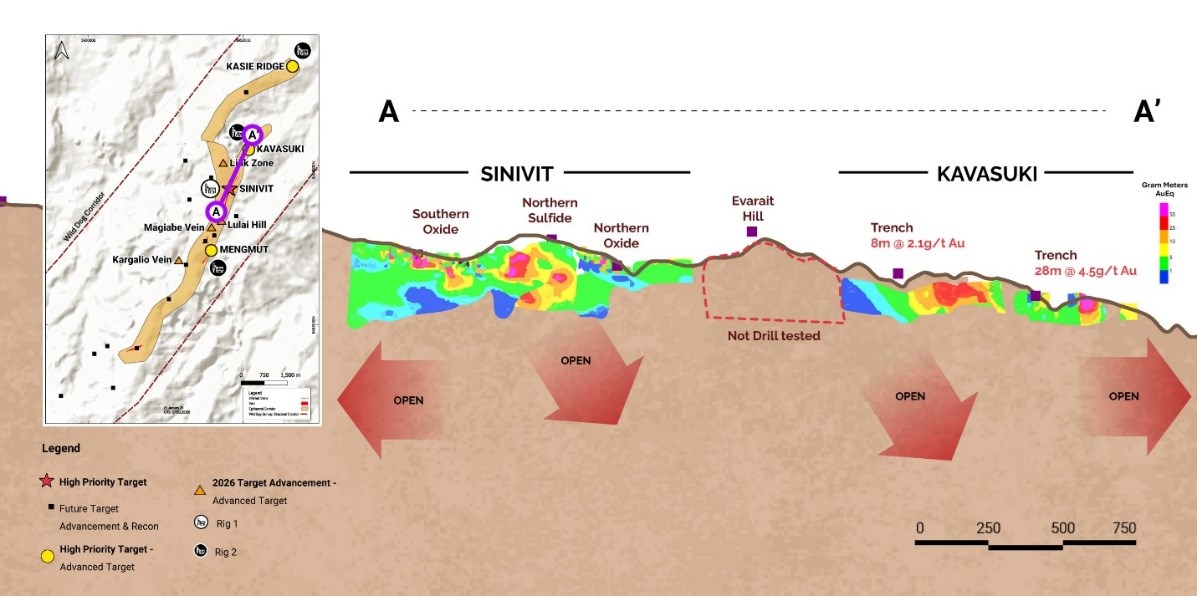
Figure 1:Wild Dog Structural Corridor showing the pipeline of epithermal targets defined from historical and recent work. Long section looking west highlights the approximately 3 km strike extent of the Sinivit-Kavasuki area within the broader 15 km corridor.
To view an enhanced version of this graphic, please visit:
https://images.newsfilecorp.com/files/11018/288061_4026ef0cc48f39bd_002full.jpg
Kavasuki Drilling Update
The Kavasuki vein system extends over approximately 900 metres of strike length and forms part of the broader Sinivit-Kavasuki mineralized corridor, which represents roughly 3 km of the 15 km Wild Dog Structural Corridor. Three diamond drill holes have been completed, with a fourth hole underway (Figures 2 and 3).
The Company recently reported strong initial results from drill hole KVH-01 which returned:
- 58.9 metres @ 2.50 g/t AuEq from 38.6m (2.43 g/t Au, 2.75 g/t Ag, 0.02% Cu), including
- 4.6 metres @ 8.56 g/t AuEq from 49.0 m (8.24 g/t Au, 10.19 g/t Ag, 0.13% Cu)
- And 18.1 metres @ 2.14 g/t AuEq from 100.6 m (2.08 g/t Au, 1.60 g/t Ag, 0.03% Cu)
See the Company news release dated March 3, 2026, for details.
Mineralization is hosted within multi-phase hydrothermal quartz breccia containing sulphides including pyrite, chalcopyrite and minor bornite, consistent with a structurally controlled epithermal vein system.
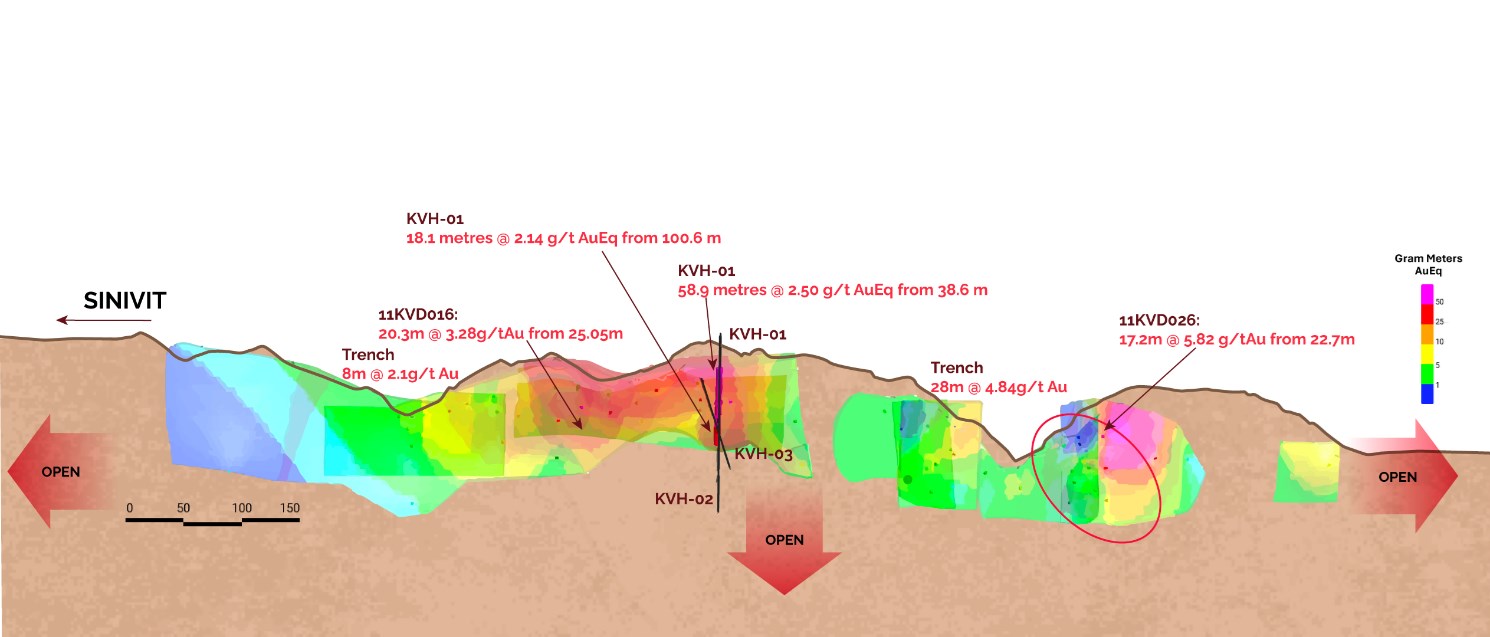
Figure 2: Long section looking west along Kavasuki illustrating historic drill intercepts, trench results and gram-metre AuEq distribution. Mineralization defines a structurally controlled epithermal vein system extending over approximately 900 m.
To view an enhanced version of this graphic, please visit:
https://images.newsfilecorp.com/files/11018/288061_4026ef0cc48f39bd_003full.jpg
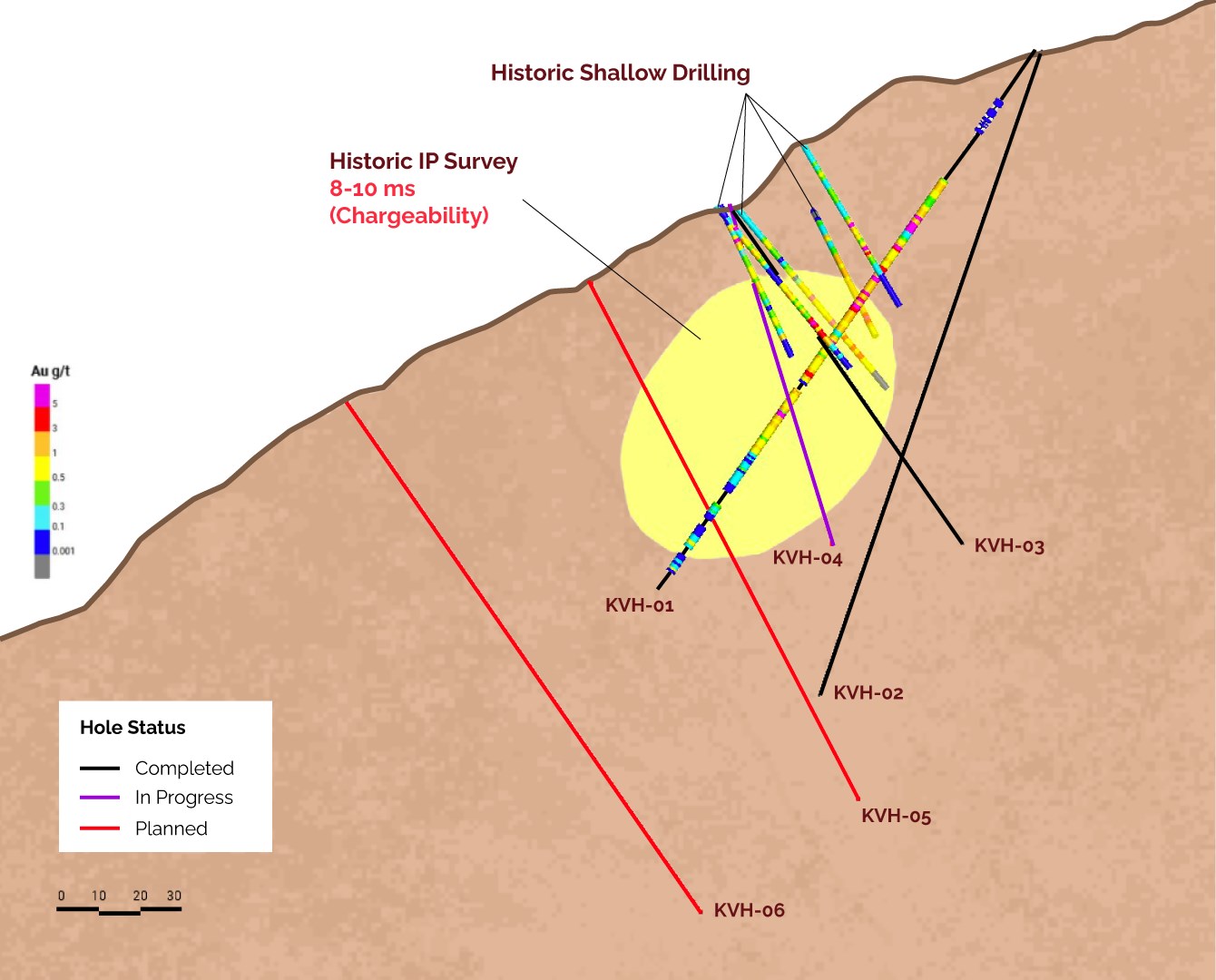
Figure 3: Cross section (+/-25 m looking NE) of the Kavasuki vein system showing recent drilling (KVH-01 to KVH-03) and planned follow-up drill holes designed to test the interpreted west-dipping structure and evaluate continuity of mineralization within the broader Sinivit-Kavasuki corridor.
To view an enhanced version of this graphic, please visit:
https://images.newsfilecorp.com/files/11018/288061_4026ef0cc48f39bd_004full.jpg
Drill hole KVH-03 has now been completed, with geological logging identifying strong silica flooding and multi-phase quartz veining from approximately 5 m to 51 m downhole. Detailed logging and sampling are currently underway (Figures 4 and 5).
KVH-03 was designed to test the west-dipping structural interpretation of the Kavasuki vein system following structural measurements obtained from earlier drilling. Drill targeting will continue to be refined as geological information from the current program is integrated.
Drilling has now progressed to KVH-04, which is being drilled from the same pad and designed to test beneath the KVH-03 intercept. The close spacing of these holes is intended to better constrain the structural controls on mineralization, evaluate short-range grade and structural continuity within the vein system, and assess potential grade variability commonly observed in epithermal gold systems.
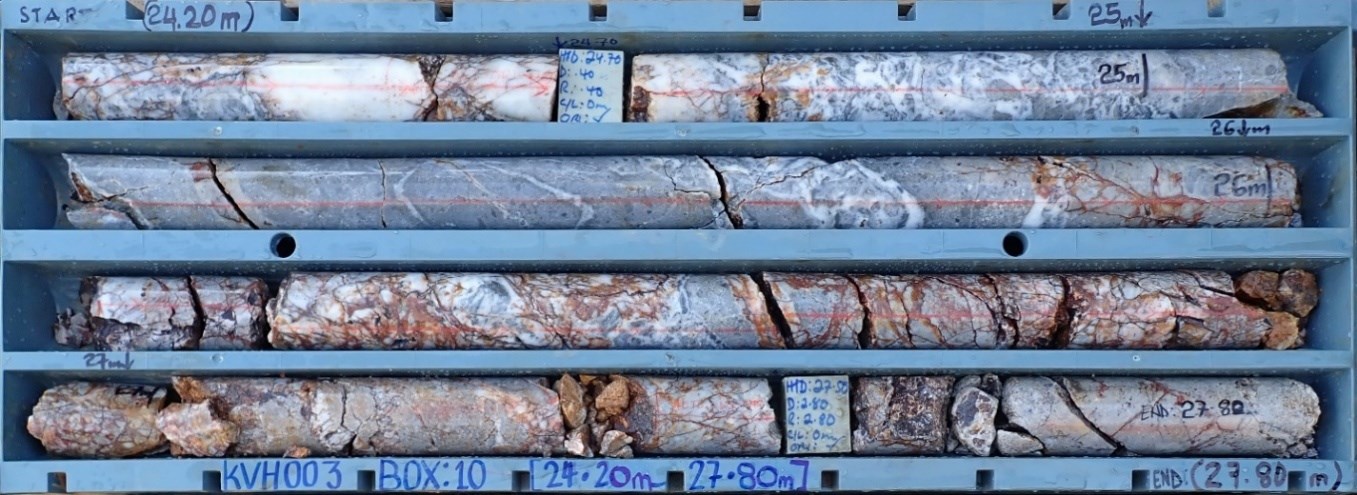
Figure 4: Drill core from the Kavasuki hole KVH-03 (24.2-27.8 m) showing intense silica flooding and multi-phase quartz veining within hydrothermally altered host rock.
To view an enhanced version of this graphic, please visit:
https://images.newsfilecorp.com/files/11018/288061_4026ef0cc48f39bd_005full.jpg
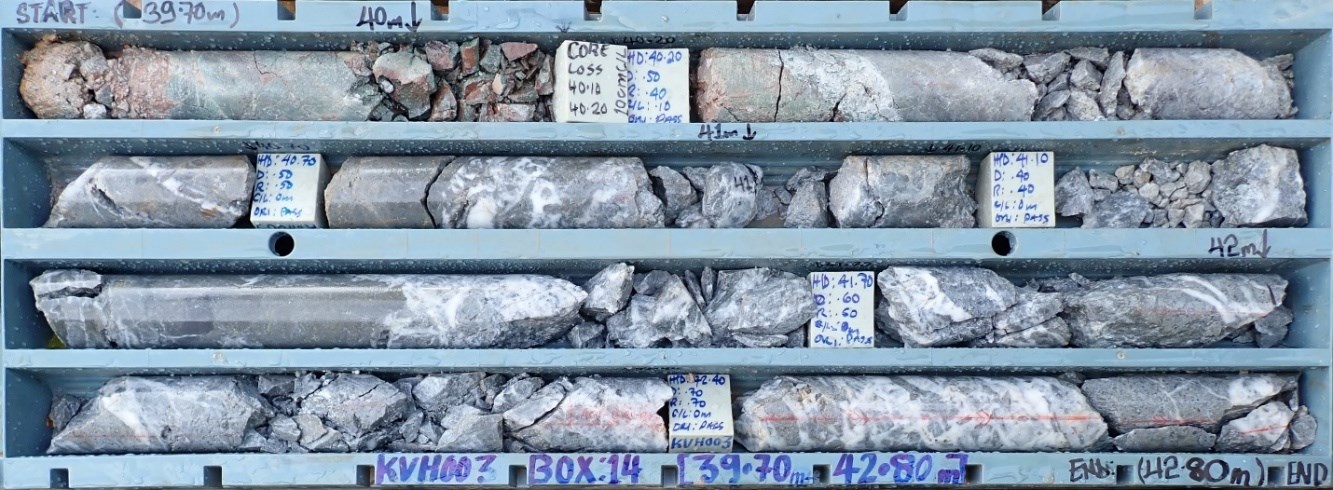
Figure 5: Drill core from the Kavasuki hole KVH-03 (39.7-42.8 m) showing intense silica flooding and multi-phase quartz veining within hydrothermally altered host rock.
To view an enhanced version of this graphic, please visit:
https://images.newsfilecorp.com/files/11018/288061_4026ef0cc48f39bd_006full.jpg
Kasie Ridge - First Drill Test Beneath Lithocap
The Company is providing an initial update from the first drill hole currently underway at the Kasie Ridge target within the Wild Dog Project.
The first hole, KAS-01, has now penetrated through the upper clay-dominant portion of the advanced argillic lithocap. Geological logging to date indicates propylitic alteration characterised by chlorite, epidote and magnetite, with narrow epidote-quartz veinlets observed within volcanic host rocks.
Localized visible chalcopyrite has been observed during preliminary core logging (Figures 6 and 7). Portable XRF measurements support the visual identification of copper-bearing sulphides; however, these readings are preliminary field-screening data only and are not a substitute for laboratory geochemical assays. No quantitative copper grades are being reported from portable XRF data.
These early observations indicate hydrothermal alteration beneath the lithocap and are considered encouraging in the context of the Company's exploration model.
Drilling of hole KAS-01 remains ongoing, and geological logging and sampling will continue as the hole advances. Further updates will be provided once the hole is completed and laboratory analytical results are received.
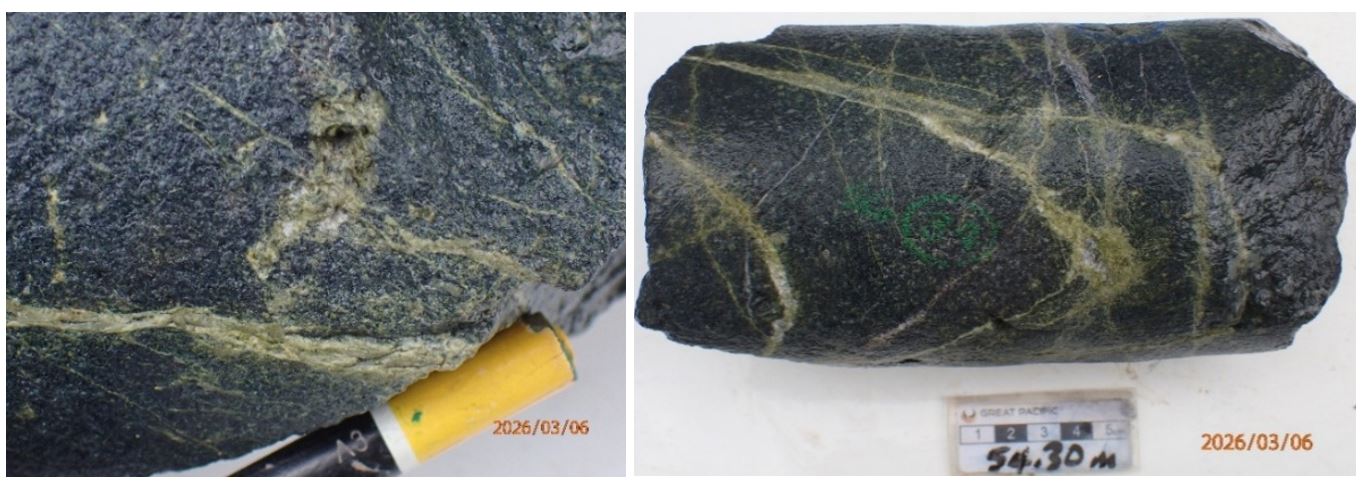
Figure 6: Drill core from the Kasie Ridge drill hole showing strongly propylitic-altered volcanic host rock characterised by chlorite-epidote alteration and cross-cutting epidote-quartz veinlets.
To view an enhanced version of this graphic, please visit:
https://images.newsfilecorp.com/files/11018/288061_capture6.jpg
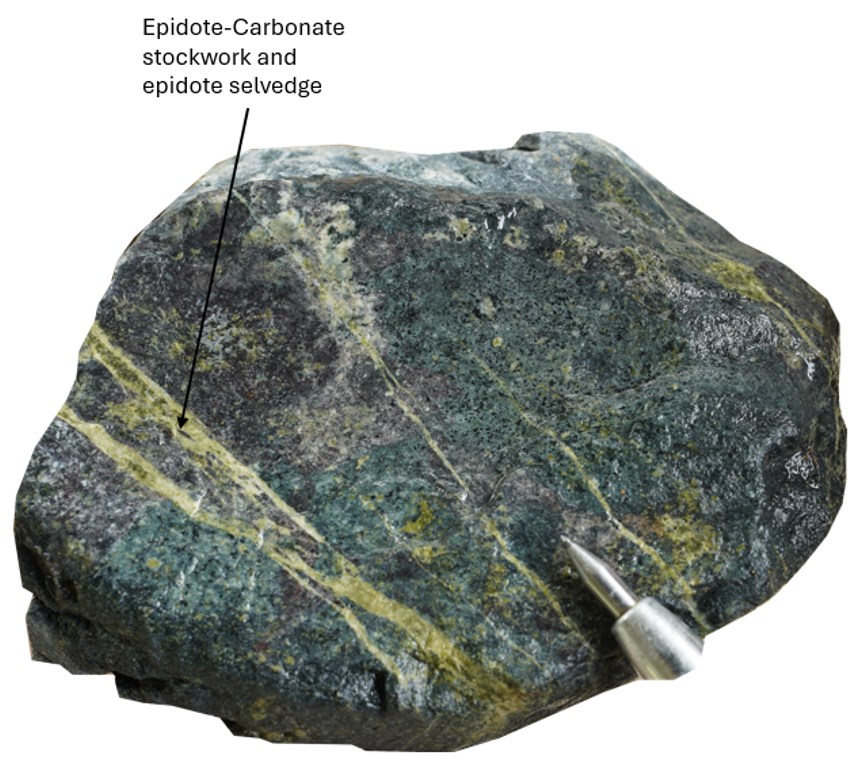
Figure 7: Propylitic-altered volcanic host rock from the Kasie Ridge drill hole showing epidote-carbonate-quartz stockwork veining with epidote selvages from 50-56 m.
To view an enhanced version of this graphic, please visit:
https://images.newsfilecorp.com/files/11018/288061_4026ef0cc48f39bd_009full.jpg
On behalf of Great Pacific Gold:
Greg McCunn
Chief Executive Officer and Director
Table 1: Kavasuki Drill Hole Details (PNG94 UTM Zone 56 coordinates).
| Hole ID | Easting | Northing | RL | Dip | Azi | Max Depth (m) | Status |
| KVH-01 | 395247.0 | 9490693.0 | 842 | -55 | 304 | 159 | Complete |
| KVH-02 | 395248.0 | 9490692.0 | 842 | -71 | 304 | 165 | Complete |
| KVH-03 | 395178.0 | 9490701.0 | 803 | -53 | 100 | 113.7 | Complete |
| KVH-04 | 395179.4 | 9490700.5 | 803 | -72 | 100 | TBD | In Progress |
Table 2: Kasie Ridge Drill Hole Details (PNG94 UTM Zone 56 coordinates).
| Hole ID | Easting | Northing | RL | Dip | Azi | Max Depth (m) | Status |
| KAS-01 | 396599.6 | 9493496.5 | 595 | -69 | 176 | TBD | Drilling |
Table 3: Kavasuki Drill Hole Key Assay Results
| Hole ID | From (m) | To (m) | Interval1 (m) | Gold (g/t) | Silver (g/t) | Copper (%) | Gold Eq.2 (g/t) |
| KVH-01 | 38.60 | 97.50 | 58.9 | 2.43 | 2.75 | 0.02 | 2.50 |
| Including | 49.00 | 53.60 | 4.60 | 8.24 | 10.19 | 0.13 | 8.56 |
| KVH-01 | 100.60 | 118.70 | 18.1 | 2.08 | 1.60 | 0.03 | 2.14 |
Notes:
- Drill highlights presented above are core lengths (true widths are not known at this time).
- Gold equivalent (AuEq) exploration results are calculated using longer-term commodity prices with a copper price of US$4.50/lb, a silver price of US$27.50/oz and a gold price of US$2,000/oz. No metallurgical testing has been carried out on Wild Dog mineralized samples. For AuEq calculations, recovery assumptions of Au 92.6%, Ag 78.0%, and Cu 94.0% were used based on K92 Mining's stated recovery results in an Updated Definitive Feasibility Study for the Kainantu mine.
Qualified Person
The technical content of this news release has been reviewed, verified and approved by Callum Spink, the Company's Vice President, Exploration, who is a member of the Australian Institute of Geoscientists, MAIG, and a Qualified Person as defined by National Instrument 43-101 Standards of Disclosure for Mineral Projects. Mr. Spink is responsible for the technical content of this news release. Mr. Spink is not independent of the Company.
Quality Assurance / Quality Control (QAQC)
The Company follows industry-standard Quality Assurance and Quality Control (QA/QC) procedures. Diamond drill core (HQ and PQ diameter) was sawn in half, with one-half submitted to Intertek Minerals Ltd. in Lae, Papua New Guinea, an ISO 9001-certified independent analytical laboratory with internationally recognized quality standards.
Gold analyses were completed by fire assay, with copper and silver initially determined by aqua regia digestion and atomic absorption and subsequently updated using four-acid digestion (MS48) multi-element analysis.
Certified reference materials (standards) and blanks were inserted into the sample stream at industry-standard frequencies, including routine insertion of blanks following mineralized intervals. All assay batches received to date have passed QA/QC review and fall within acceptable tolerance limits.
Core recoveries were within acceptable ranges, and sampling procedures were carefully managed in areas of variable ground conditions.
About Great Pacific Gold
Great Pacific Gold's vision is to become the leading gold-copper development company in Papua New Guinea ("PNG"). The Company has a portfolio of exploration-stage projects in PNG, as follows:
- Wild Dog Project:the Company's flagship project is located in the East New Britain Province of PNG. The project consists of a large-scale epithermal target, the Wild Dog structural corridor, stretching 15 km in strike length, with geophysical data suggesting significant depth extent. The survey also highlighted the Magiabe porphyry target, adjacent to the epithermal target and potentially 1,000 metres in diameter and over 2,000 metres deep. Drilling of the epithermal structure on the Sinivit target has yielded high-grade results, including WDG-08 which intercepted 8.4 metres at 50 g/t AuEq from 154 metres. The current drilling program will extend into 2026 with the second drill rig now operational.
- Kesar Project:located in the Eastern Highlands Province of PNG and contiguous with the mine tenements of K92 Mining Inc. ("K92"), the Kesar Project is a greenfield exploration project with several high-priority targets in close proximity to the property boundary with K92. Multiple epithermal veins at Kesar are on strike and have the same orientation as key K92 deposits, such as Kora. Exploration work to date by the Company at the Kesar Project has shown that these veins have high grades of gold present in outcrop and very elevated gold in soil grades, coincident with aeromagnetic highs. The Company conducted a diamond drill program on key target areas at the Kesar Project from November 2024 to May 2025 and have developed a follow-up Phase 2 program for 2026.
- Arau Project:also located in the Eastern Highlands Province of PNG, the Arau Project is south of and contiguous to the mine tenements of K92. Arau contains the highly prospective Mt. Victor exploration target with potential for a high sulphidation epithermal gold-base metal deposit. A Phase 1 Reverse Circulation drilling program was completed at Mt. Victor in August 2024, with encouraging results. The Arau Project includes the Elandora licence, which also contains various epithermal and copper-gold porphyry targets.
The Company also holds the Tinga Valley Project in PNG.
Forward-Looking Statements
Information set forth in this news release contains forward-looking statements that are based on assumptions as of the date of this news release. These statements reflect management's current estimates, beliefs, intentions and expectations. They are not guarantees of future performance. Great Pacific Gold cautions that all forward-looking statements are inherently uncertain and that actual performance may be affected by many material factors, most of which are beyond their respective control. Such factors include, among other things: risks and uncertainties relating to Great Pacific Gold's limited operating history, its exploration and development activities on its mineral properties and the need to comply with environmental and governmental regulations. Accordingly, actual and future events, conditions and results may differ materially from the estimates, beliefs, intentions and expectations expressed or implied in the forward-looking information. Except as required under applicable securities legislation, Great Pacific Gold does not undertake to publicly update or revise forward-looking information.
Mineralization at the properties held by K92 Mining Inc. and at the Wafi-Golpu deposit is not necessarily indicative of mineralization at the Wild Dog Project.
Neither TSX Venture Exchange nor its Regulation Services Provider (as that term is defined in the policies of the TSX Venture Exchange) accepts responsibility for the adequacy or accuracy of this release.
To view the source version of this press release, please visit https://www.newsfilecorp.com/release/288061
Source: Great Pacific Gold Corp.
© 2026 Newsfile Corp. All rights reserved.