



Navitas Debuts Revolutionary 800 V–6 V Power Delivery Board at NVIDIA GTC 2026
The breakthrough, 800 V–6 VDC-DC power delivery board eliminates traditional 48V intermediate bus converter stage while improving system efficiency, reliability, cost, and compute density. The platform is being showcased atNVIDIA GTC 2026.
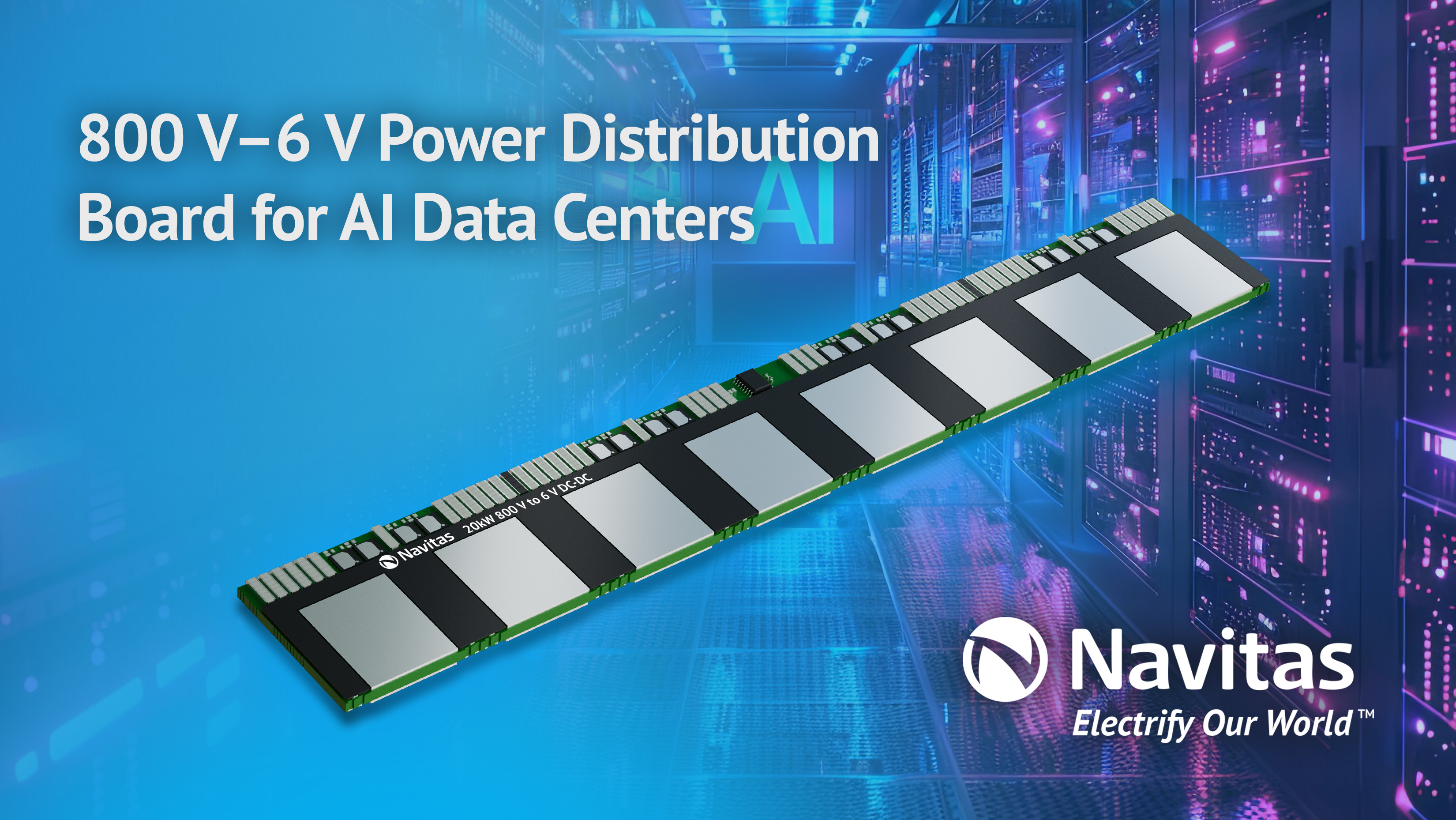
TORRANCE, Calif., March 16, 2026 (GLOBE NEWSWIRE) -- Navitas Semiconductor (Nasdaq: NVTS), a leader in GaNFast™ gallium nitride (GaN) and GeneSiC™ silicon carbide (SiC) power semiconductors, announced its latest DC-DC power delivery board (PDB) powered by GaNFast™ technology, enabling direct conversion from 800 V to 6 V in one power stage. This breakthrough solution eliminates the traditional 48 V intermediate bus converter (IBC) stage within the compute server trays, maximizing system efficiency, reliability, and valuable real estate, to deliver a simple power delivery solution to support advanced NVIDIA AI infrastructure.
Traditional enterprise and cloud architectures built around legacy 54 V in-rack power distribution are increasingly unable to support the megawatt rack densities demanded by future accelerated computing platforms. Addressing these escalating power requirements requires a fundamental shift in data center power architecture.
NVIDIA is leading the transition to 800 VDC data center power infrastructure, and Navitas is delivering the right technologies to support this shift. Navitas’s 800 V–50 V DC-DC platform introduction was a breakthrough in efficiency and power density; however, 800 V to 50 V conversion still required one more power conversion stage to deliver to Voltage Regulator Modules (VRM), which typically operated at 12 V or below.
As NVIDIA MGX architecture evolves with the future rack design for high compute and power density systems for greater AI performance, they will require direct 800 V-to-6 V (or 12 V) conversion to maximize rack power density and overall efficiency. Converting directly from 800 V eliminates the 50 V IBC stage, reducing conversion losses, freeing valuable board space, and improving end-to-end system efficiency. Navitas’s 6 V output architecture improves system performance versus other already released PDBs by cutting the VRM conversion ratio in half.
Navitas’s 800 V–6 V DC-DC PDB targets to deliver up to 96.5% peak efficiency at full load with 1 MHz switching frequency, enabling a power density of 2,100 W/in³. Approximately 20% thinner than a mobile phone, its ultra-low profile allows for extremely close integration with the GPU board, maximizing transient performance and enhancing power distribution efficiency.
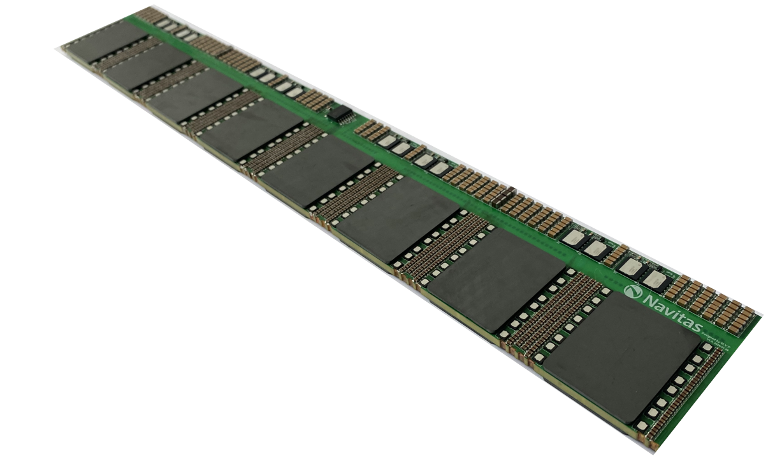
Next-gen 800 V–6 V DC-DC PDB eliminates the 48 V IBC stage, increasing system efficiency, reliability, and saving valuable PCB area.
The primary side employs 16 × 650 V GaNFast FETs in the latest DFN8×8 dual-cooled package, configured in a stacked full-bridge. Center-tapped outputs use 25 V silicon MOSFETs. 1 MHz switching enables the use of the smallest passives and planar magnetics, delivering maximum power density.
“With our industry-leading 800 V-to-6 V DC-DC PDB, Navitas is setting a new benchmark for data center power architectures. By eliminating an entire conversion stage, we lower system cost and power losses while freeing up valuable board space, enabling customers to dedicate more real estate to compute, memory, and GPUs and to unlock maximum performance for AI workloads,” said Chris Allexandre, President and CEO of Navitas Semiconductor. “Our latest GaNFast™ based solution shows how Navitas is pushing the boundaries of AI data center power.”
The PDB is being showcased at NVIDIA GTC 2026, March 16-19, San Jose, and also at the Navitas booth (#2027) at APEC, March 22–26, in San Antonio, TX.
To find out more information about this solution, please reach out to your Navitas representative or write to info@navitassemi.com.
About Navitas
Navitas Semiconductor (Nasdaq: NVTS) is a next-generation power semiconductor leader in gallium nitride (GaN) and IC integrated devices, and high-voltage silicon carbide (SiC) technology, driving innovation across AI data centers, energy and grid infrastructure, performance computing, and industrial electrification. With more than 30 years of combined expertise in wide bandgap technologies, GaNFast™ power ICs integrate GaN power, drive, control, sensing, and protection, delivering faster power delivery, higher system density, and greater efficiency. GeneSiC™ high-voltage SiC devices leverage patented trench-assisted planar technology to provide industry-leading voltage capability, efficiency, and reliability for medium-voltage grid and infrastructure applications. Navitas has over 300 patents issued or pending and is the world’s first semiconductor company to be CarbonNeutral®-certified.
Navitas Semiconductor, GaNFast, GaNSense, GeneSiC, and the Navitas logo are trademarks or registered trademarks of Navitas Semiconductor Limited and affiliates. All other brands, product names, and marks are or may be trademarks or registered trademarks used to identify products or services of their respective owners.
Contact Information
Navitas Semiconductor
Vipin Bothra
info@navitassemi.com
Navitas Investor Contacts
Leanne Sievers | Brett Perry
Shelton Group
sheltonir@sheltongroup.com
Cautionary Statement Regarding Forward-Looking Statements
This press release includes “forward-looking statements” within the meaning of Section 21E of the Securities Exchange Act of 1934, as amended. Forward-looking statements are attempts to predict or indicate future events or trends or similar statements that are not a reflection of historical fact. Forward-looking statements may be identified by the use of words such as “we expect,” or “are expected to be,” “estimate,” “plan,” “project,” “forecast,” “intend,” “anticipate,” “believe,” “seek,” or other similar expressions. Forward-looking statements are made based on estimates and forecasts of financial and performance metrics, projections of market opportunity and market share and current indications of customer interest, all of which are based on various assumptions, whether or not identified in this press release. All such statements are based on current expectations of the management of Navitas and are not predictions of actual future performance. Forward-looking statements are provided for illustrative purposes only and are not intended to serve as, and must not be relied on by any investor as, a guarantee, an assurance, a prediction or a definitive statement of fact or probability. Actual events and circumstances are difficult or impossible to predict and will differ from assumptions and expectations. Many actual events and circumstances that affect performance are beyond the control of Navitas, and forward-looking statements are subject to a number of uncertainties. Our business is subject to certain risks that could materially and adversely affect our business, financial condition, results of operations, or the value of our securities. . For Navitas, these and other risk factors are discussed in the Risk Factors section of our most recent annual report on Form 10-K, as updated in the Risk Factors section of our most recent quarterly report on Form 10-Q, and in other documents we file with the SEC. If any of these risks, as discussed in more detail in our SEC reports, materialize or if our assumptions underlying forward-looking statements prove to be incorrect, actual results could differ materially from the results implied by these forward-looking statements. Examples of some of these risk factors include:
- Risks Related to High-Power Markets: We intend to focus on AI data centers, performance computing, energy and grid infrastructure, and industrial electrification, and de-emphasize mobile and consumer products. We may not successfully execute our strategic transition to these new markets and customer applications, which could adversely affect our business, results of operations, and financial condition. This strategic realignment entails significant operational, technical, and market risks. Our success in these markets depends on factors including our ability to (i) develop and scale semiconductor solutions that meet demanding power, efficiency, and performance requirements of our customers; (ii) compete against established incumbents with substantial R&D and manufacturing resources; (iii) anticipate rapidly evolving customer needs and technological standards in these high-power and high-performance segments; and (iv) secure design wins and long-term supply agreements in new and unfamiliar market segments.
- Market Acceptance and Addressable Market Uncertainty: The demand for our products, and our customers’ products, in new or emerging markets is difficult to forecast, as customer preferences may not be fully known and can evolve rapidly. Further, demand for our products depends on the acceptance of underlying new and developing system architectures. For example, our predictions for the use of GaN- and SiC-based products in 800V AI data center power applications depend on assumptions regarding the acceptance and growth of 800V systems themselves.
- Unpredictable Competitive Dynamics and Industry Conditions: To the extent our products reshape or create new market landscapes, the competitive environment may evolve in unexpected ways. For example, new competitors may emerge, or traditional competitors with established R&D and manufacturing resources, and long-standing customer relationships, may choose to offer competitive GaN or high-voltage SiC solutions. In addition, the semiconductor sector is known for cyclical volatility. This inherent unpredictability is amplified in new and emerging markets, where demand can swing sharply due to macroeconomic events, supply chain shocks, regulatory changes, or technology cycles.
- Other Risk Factors: Other risk factors include Navitas’ ability to diversify its customer base and develop relationships in new markets or regions; the possibility that the expected growth of our business will not be realized, or will not be realized within expected time periods, due to the above factors as well as others; Navitas’ ability to scale its technology into new markets and applications; the effects of competition on Navitas’ business, including actions of competitors with an established presence and resources in markets we hope to penetrate or by competitors to take market share in the markets we are deprioritizing; the level of demand in our customers’ end markets and our customers’ ability to predict such demand, both generally and with respect to successive generations of products or technology; Navitas’ ability to attract, train and retain key qualified personnel; changes in government trade policies, including the imposition of tariffs and the regulation of cross-border investments, particularly involving the United States and China; other regulatory developments in the United States, China and other countries; the impact of events such as epidemics and pandemics in locations where our products are manufactured and sold; and Navitas’ ability to protect its intellectual property rights.
Photos accompanying this announcement are available at
https://www.globenewswire.com/NewsRoom/AttachmentNg/4d63d622-de0d-4b92-b1ea-6385f088eff3
https://www.globenewswire.com/NewsRoom/AttachmentNg/b8caf0f9-ec7d-4344-b7e8-e618c0714e99

© 2026 GlobeNewswire, Inc. All Rights Reserved.