



Jeffs’ Brands and Scanary: The Radar Revolution That Could Transform the Homeland-Security Market
Tel Aviv, Israel, Dec. 24, 2025 (GLOBE NEWSWIRE) -- Jeffs ' Brands Ltd. (Nasdaq: JFBR) (“Jeffs’ Brands”), a data-driven e-commerce company strategically pivoting into homeland security, today provided additional information regarding Scanary Ltd. (“Scanary”), an Israeli deep-tech startup 's groundbreaking AI-powered radar system that promises to redefine concealed threat detection without disrupting the flow of people. In an era of emerging security threats-from mass shootings to terrorist attacks in crowded public spaces—traditional security screening methods are increasingly inadequate. Long lines at metal detectors and X-ray machines create bottlenecks, frustrate crowds, and leave vulnerabilities in open areas where threats can enter undetected. Enter Scanary Ltd. (“Scanary”), an Israeli deep-tech startup 's groundbreaking AI-powered radar system that promises to redefine concealed threat detection without disrupting the flow of people.
To bring this revolutionary technology to global markets, Jeffs ' Brands identified Scanary 's immense potential early on and, through Jeffs ' Brands subsidiary, KeepZone AI Inc. (“KeepZone”), Jeffs ' Brands secured the exclusive distribution rights for Scanary’s technology in key regions, accelerating the deployment of this solution.
Founded in 2024 by defense and high-tech veterans from the Israeli Defense Forces’s elite units, Scanary emerged in mid-2025 with a patented technology that combines electromagnetic radar imaging with advanced artificial intelligence.
How Scanary Works: Frictionless, Standoff Detection
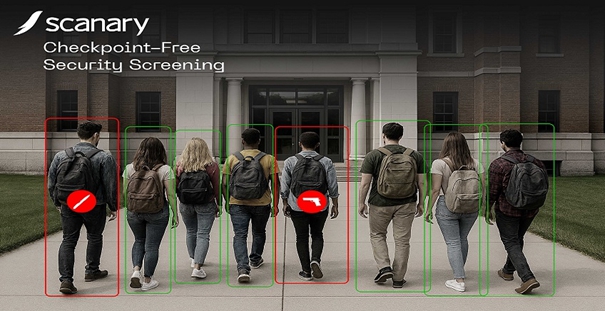
At its core, Scanary employs proprietary near-field radar sensors combined with artificial intelligence to generate three-dimensional images of people and carried objects in open environments, with flexible sensor placement of up to approximately 10 meters. Individuals move naturally through the screening area without stopping, emptying pockets, or removing personal items such as belts or shoes. Operating continuously and in real time, the system enables high-throughput screening across large, open spaces while maintaining a seamless visitor experience.
The AI engine classifies threats in real-time: distinguishing guns, knives, or explosives from harmless items like phones or keys. Alerts overlay on existing CCTV feeds, pinpointing threats with 3D visualizations and notifying security via mobile devices.
Crucially, it 's privacy-first: no facial recognition, no biometric data, no body imaging—just material and shape analysis. It holds Conformité Européenne (“CE”) and General Data Protection Regulation (“GDPR”) approvals in Europe, with U.S. processes underway.
A Game-Changer for High-Threat Venues
Scanary targets exactly where traditional checkpoints fail -- airports terminals, stadiums, transit hubs, malls, concerts, and border areas. A recent pilot at Pais Arena Jerusalem during December 2025 concerts, orchestrated by KeepZone, validated the system 's real-world performance.
Reshaping Homeland Security
If widely adopted, Scanary could fundamentally alter homeland security:
- Eliminate Bottlenecks: Frictionless screening means no line, improving crowd flow and reducing secondary risks like stampedes in evacuations.
- Proactive Threat Neutralization: Remote detection allows security to intercept threats before they reach choke points, enabling layered defense in "soft targets. "
- Cost and Resource Efficiency: Fewer personnel needed for manual checks, which can result in lower operational costs in high-traffic venues.
- Enhanced Privacy and Experience: Respectful, non-intrusive scans boost public acceptance, contrasting with invasive pat-downs or imaging scanners.
- Scalability Against Evolving Threats: AI adaptation counters new concealment methods, from non-metallic explosives to 3D-printed weapons.
Jeffs ' Brands Drives Scanary 's Rapid Global Acceleration
Through its subsidiary, Jeffs ' Brands secured exclusive distribution rights in key markets, including Canada, Germany, the United Arab Emirates, and stadiums in Israel. KeepZone has committed a structured $1 million investment (repayable via revenue shares) in Scanary and appointed security expert Alon Dayan as the Chief Executive Officer of KeepZone, demonstrating bold foresight in recognizing Scanary as a disruptive force in the homeland security market. By expanding the partnership and facilitating a successful live pilot at Pais Arena Jerusalem in December 2025, Jeffs ' Brands, through its subsidiary, has played a pivotal role in accelerating Scanary 's path to global deployment.
In a global security screening market projected to grow significantly, technologies like Scanary align with trends toward contactless, AI-driven solutions-nechoing the U.S. Department of Homeland Security and Transportation Security Administration’s pushes for touchless screening to reduce physical contact and wait times.
While challenges remain, such as obtaining regulatory approvals, integration costs, and false positives in diverse crowds, Scanary, bolstered by partners like Jeffs ' Brands, represents a leap forward. The future of homeland security has the potential to be checkpoint-free, radar-guided, and invisibly vigilant. Scanary isn 't just detecting threats- it 's reimagining how we prevent them.
About Jeffs’ Brands
Jeffs’ Brands is a data-driven company that has recently pivoted into the global homeland security sector through its wholly-owned subsidiary, KeepZone AI Inc. Following the definitive distribution agreement with Scanary Ltd., in December 2025. Jeffs’ Brands aims to deliver comprehensive, multi-layered security ecosystems for critical infrastructure worldwide, capitalizing on the homeland security market’s significant growth potential while leveraging its expertise in data-driven operations.
For more information on Jeffs’ Brands visit https://jeffsbrands.com.
Forward-Looking Statement Disclaimer
This press release contains “forward-looking statements” within the meaning of Section 27A of the Securities Act of 1933, as amended, and Section 21E of the Securities Exchange Act of 1934, as amended, that are intended to be covered by the “safe harbor” created by those sections. Forward-looking statements, which are based on certain assumptions and describe the Company’s future plans, strategies and expectations, can generally be identified by the use of forward-looking terms such as “believe,” “expect,” “may,” “should,” “could,” “seek,” “intend,” “plan,” “goal,” “estimate,” “anticipate” or other comparable terms. For example, the Company is using forward-looking statements when discussing the Company’s ability to capitalize on opportunities in the homeland security market; and its expectations regarding the impact of the agreement with Scanary; and its belief that Scanary’s technology could fundamentally reshape homeland security, eliminate security bottlenecks, enable proactive threat detection, reduce operational costs, gain widespread adoption across high-threat venues, and align with global trends toward contactless and AI-driven security solutions.. Instead, they are based only on the Company’s current beliefs, expectations and assumptions regarding the future of the Company’s business, future plans and strategies, projections, anticipated events and trends, the economy and other future conditions. Because forward-looking statements relate to the future, they are subject to inherent uncertainties, risks and changes in circumstances that are difficult to predict and many of which are outside of the Company’s control. The Company’s actual results and financial condition may differ materially from those indicated in the forward-looking statements. Therefore, you should not rely on any of these forward-looking statements. Important factors that could cause the Company’s actual results and financial condition to differ materially from those indicated in the forward-looking statements include, among others, the following: the Company’s ability to successfully execute its strategic transition, including meeting its expectations regarding revenue growth, customer adoption and the demand for homeland security and advanced technology solutions;; the overall global economic environment; the impact of competition and new e-commerce technologies; general market, political and economic conditions in the countries in which the Company operates; projected capital expenditures and liquidity; the impact of possible changes in Amazon’s policies and terms of use; the impact of the conditions in Israel; and the other risks and uncertainties described in the Company’s Annual Report on Form 20-F for the year ended December 31, 2024, filed with the U.S. Securities and Exchange Commission (“SEC”), on March 31, 2025, and the Company’s other filings with the SEC. The Company undertakes no obligation to publicly update any forward-looking statement, whether written or oral, that may be made from time to time, whether as a result of new information, future developments or otherwise.
Investor Relations Contact:
Michal Efraty
Adi and Michal PR- IR
Investor Relations, Israel
michal@efraty.com

© 2025 GlobeNewswire, Inc. All Rights Reserved.