



Vadzo Imaging Evaluates FPD-Link III vs MIPI CSI-2 for Embedded Camera Integration
When the cable length exceeds what board-level signaling can sustain, no software workaround closes the gap. Vadzo Imaging examines how FPD-Link III and MIPI CSI-2 determine interface selection, cable reach, bandwidth architecture, and deployment outcome across automotive and industrial embedded camera systems.
FORT WORTH, TX / ACCESS Newswire / June 5, 2026 /Vadzo Imaging, a globally trusted provider of high-performance embedded vision systems, today publishes a definitive technical breakdown of FPD-Link III versus MIPI CSI-2 embedded camera interface architecture. For system integrators, OEMs, hardware engineers, and vision system engineers, the choice between a long-distance camera interface and a board-level MIPI CSI-2 camera determines cable reach, bandwidth capability, and integration timeline before a single frame reaches the application processor. Vadzo Imaging builds its embedded camera portfolio across both interfaces where the application demands it and explains precisely where each belongs.
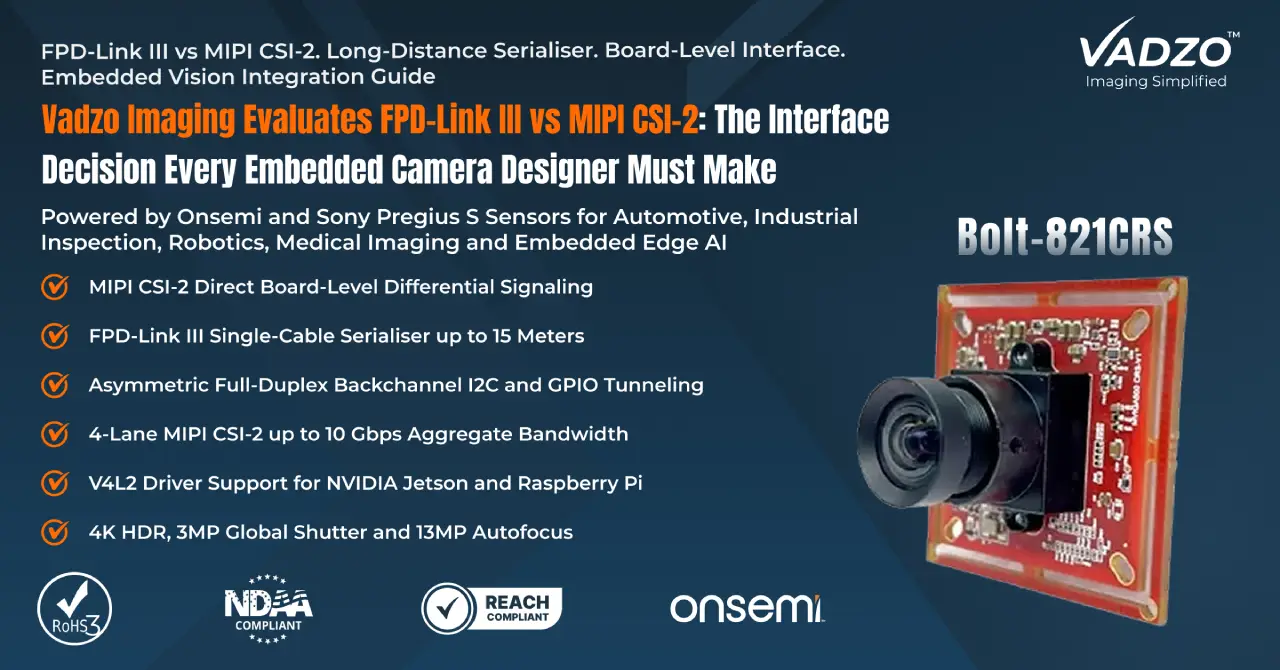
MIPI CSI-2: When Low-Latency Camera Interface Performance Is the Primary Requirement
MIPI CSI-2 is a high-speed differential signaling interface that connects a sensor directly to a host processor over a short PCB trace or flex cable, delivering raw image data at multi-gigabit bandwidth across 1, 2, or 4 data lanes with Clock-Data Recovery at the receiver PHY. The V4L2 driver framework makes a Raspberry Pi MIPI camera or NVIDIA Jetson module operational from first bring-up without custom driver development. There is no serialiser, no deserialiser, and no PoC Filter Network between the sensor and the processor. MIPI CSI-2 is a direct electrical connection, and that directness is its primary engineering advantage. Every Custom MIPI Camera from Vadzo Imaging leverages this to deliver the lowest-latency embedded camera interface for board-level integration.
Vadzo Imaging addresses board-level embedded vision with two validated MIPI CSI-2 models covering 4K HDR color and global shutter monochrome imaging. The AR0821 Color 4K MIPI Camera delivers 8MP output at 3840x2160 on the Onsemi AR0821 BSI CMOS with HDR performance and rolling shutter architecture for high-resolution color inspection. The IMX900 3MP Mono MIPI Camera delivers 3MP monochrome global shutter output on the Sony Pregius S BSI CMOS with Quad HDR up to 120 dB and NIR sensitivity, covering precision inspection and autonomous navigation where motion integrity and extreme dynamic range are required simultaneously.
FPD-Link III: When Long-Distance Automotive Camera Interface Reach Is the Primary Requirement
FPD-Link III is a serialiser and deserialiser interface for automotive camera deployments where cable runs of 15 meters are a physical system requirement. It uses Asymmetric Full-Duplex transmission over a single coaxial or shielded twisted pair cable, carrying the forward video channel and a Back-Channel Frequency for I2C Address tunneling, GPIO Tunneling, and power delivery over the same cable. This capability does not exist in MIPI CSI-2 beyond 30 centimeters. FPD-Link III is the correct long-distance camera interface when the camera must be separated from the processor by distances that board-level signaling cannot bridge.
The AR0821 HDR FPD-Link III Camera from Vadzo Imaging delivers exactly this. For automotive camera interface deployments where the sensor mounts at the vehicle perimeter, FPD-Link III eliminates the signal integrity failure that unserialised differential signaling introduces over long cable runs. For industrial embedded camera systems requiring physical isolation between imaging head and processor, FPD-Link III maintains full bandwidth and I2C control over a single cable.
Bandwidth, Component Count, and Cable Reach: Where FPD-Link III and MIPI CSI-2 Diverge Most
MIPI CSI-2 and FPD-Link III diverge most on bandwidth architecture and component count. A 4-lane MIPI CSI-2 interface on the 8MP AR0821 4K HDR MIPI camera delivers up to 10 Gbps directly to the host processor with no serialization stage and no PoC Filter Network insertion loss. The same resolution over FPD-Link III requires a serialiser at the camera end and a deserialiser at the processor end, adding component count, board space, and power to the design.
FPD-Link III recovers this cost when cable length is the binding constraint. A 4K FPD-Link III Camera over a 10-metre coaxial cable delivers full-bandwidth video with back-channel I2C and GPIO Tunneling that MIPI CSI-2 cannot match at that distance. For automotive and long-reach industrial embedded camera deployments, the serialiser cost is the correct engineering trade-off.
"FPD-Link III and MIPI CSI-2 are not competing standards for the same application. MIPI CSI-2 is correct when the sensor is millimeters from the processor, and bandwidth density is the primary constraint. FPD-Link III is correct when the cable runs meters, and the back channel must carry I2C and GPIO over the same conductor. A camera designer who treats them as interchangeable has already made the wrong interface decision before the schematic is open. TheAR0821 Color 4K MIPI Camera and theAR0821 FPD-Link III Camerafrom Vadzo Imaging exist, so the interface is matched to the deployment from the first design review. Specifying the wrong interface does not fail on the bench. It fails during cable qualification, at temperature, after the enclosure is sealed. " - Alwin Vincent, Product Manager, Vadzo Imaging.
Vadzo Imaging Embedded Camera Portfolio: MIPI CSI-2 and FPD-Link III Across Industrial Vision Applications
The following models represent key examples of how MIPI CSI-2 and FPD-Link III interface architecture delivers high-performance imaging across critical embedded camera deployment environments.
AR0821 Color 4K MIPI Camera: 8MP AR0821 4K HDR MIPI Camera for High-Resolution Embedded Vision
The 8MP AR0821 4K HDR MIPI camera targets high-resolution embedded AI inference, industrial inspection, and robotics, where 4K color HDR output and low-latency MIPI CSI-2 are both required at the imaging front-end. Delivering 8MP Rolling Shutter Color MIPI Camera output at 3840x2160 on the Onsemi AR0821 BSI CMOS with HDR imaging and high color sensitivity, it sustains full-resolution throughput over 4-lane MIPI CSI-2 without frame drops under continuous acquisition. This Custom MIPI Camera operates with V4L2 driver support on NVIDIA Jetson and Raspberry Pi, enabling platform-native bring-up without custom kernel modifications or proprietary middleware.
Key specs:8MP (3840x2160) | Onsemi AR0821 | Rolling Shutter | HDR | 4-Lane MIPI CSI-2 | V4L2 Driver | NVIDIA Jetson and Raspberry Pi Compatible
IMX900 3MP Mono MIPI Camera: Pregius S 3MP Mono MIPI Camera for Global Shutter Embedded Vision
The Pregius S 3MP mono MIPI camera targets precision inspection, autonomous navigation, and medical imaging, where global shutter integrity and Quad HDR dynamic range are both primary requirements. Delivering 3MP IMX900 Global Shutter MIPI Camera output on the Sony Pregius S BSI CMOS with Quad HDR up to 120 dB and NIR sensitivity at 850nm and 940nm, it maintains geometric accuracy across the full illuminance operating range. This embedded vision camera operates over MIPI CSI-2 with V4L2 driver support for production-ready deployment without proprietary middleware.
Key specs:3MP (2064x1552) | Sony IMX900 Pregius S | Global Shutter | Quad HDR 120dB | NIR 850nm and 940nm | MIPI CSI-2 | V4L2 Driver
AR0821 FPD-Link III Camera: 4K FPD-Link III Camera for Automotive and Long-Reach Integration
The AR0821 4K Rolling Shutter Camera targets automotive camera interface deployments and long-reach industrial embedded camera systems where cable distances exceed MIPI CSI-2 electrical reach. Delivering 13MP output at 4K on the Onsemi AR0821 BSI CMOS with autofocus over a single cable using FPD-Link III serialization, it maintains full-bandwidth video with back-channel I2C Address control and GPIO Tunneling over runs up to 15 meters. This AR0821 4K FPD-Link III Camera operates with PoC Filter Network power delivery, eliminating a separate power cable to the sensor module.
Key specs:8MP (3848x2168) | Onsemi AR0821| Rolling Shutter | Autofocus | FPD-Link III | Asymmetric Full-Duplex | Back-Channel I2C and GPIO | PoC Power Delivery
Applications for Vadzo MIPI CSI-2 and FPD-Link III Camera Modules Across Industries
Automotive and ADAS:Automotive deployments mount sensor modules at the vehicle perimeter while the processor sits in the cabin, requiring a long-distance camera interface that maintains full-bandwidth video and back-channel control over a single cable. The AR0821 4K FPD-Link III Camera and FPD-Link III Camera portfolio serve this architecture with Asymmetric Full-Duplex transmission, GPIO Tunneling, and PoC Filter Network power delivery over coaxial cable without a separate power conductor to the remote sensor.
Industrial Inspection and Embedded AI:Industrial inspection and embedded AI inference platforms require a low-latency camera interface that delivers 4K HDR color or global shutter monochrome data directly to the host processor with minimum component count. The AR0821 Color 4K MIPI Camera and IMX900 3MP Mono MIPI Camera portfolio delivers full-bandwidth output over 4-lane MIPI CSI-2 with V4L2 driver support across NVIDIA Jetson and Raspberry Pi without serialiser overhead.
Robotics and Autonomous Navigation:Robotics platforms require embedded camera interface solutions that deliver zero motion distortion, extreme dynamic range, and platform-native MIPI CSI-2 integration without proprietary driver dependency. The 3MP IMX900 Global Shutter MIPI Camera and 8MP AR0821 Rolling Shutter Color MIPI Camera portfolio serve this use case with Quad HDR up to 120 dB, NIR sensitivity at 850nm and 940nm, and V4L2 driver support for deterministic bring-up on all validated embedded platforms.
Medical Imaging and Precision Microscopy:Medical imaging deployments require a global shutter embedded vision camera that eliminates rolling shutter Jello effect during motorized stage movement and maintains HDR detail across bright-field and dark-field illumination. The Pregius S 3MP mono MIPI camera and Custom MIPI Camera portfolio from Vadzo Imaging deliver global shutter capture with Quad HDR over low-latency MIPI CSI-2 without post-processing compensation.
Frequently Asked Questions (FAQs)
1) What is the best 4K MIPI CSI-2 camera for embedded AI inference on NVIDIA Jetson with V4L2 driver support and no proprietary middleware?
Embedded AI inference platforms on NVIDIA Jetson lose production schedule time when the camera front-end requires a proprietary driver stack that breaks across JetPack OS versions, forcing a requalification cycle before every platform update. A 4K MIPI CSI-2 camera for production Jetson deployment needs platform-native V4L2 driver support, 4-lane bandwidth sufficient for full-resolution HDR streaming, and HDR output that delivers geometrically consistent frames to the inference pipeline across every ambient lighting condition.
The AR0821 Color 4K MIPI Camera from Vadzo Imaging delivers 8MP HDR output at 3840x2160 over 4-lane MIPI CSI-2 with up to 10 Gbps aggregate bandwidth and V4L2 driver support validated on NVIDIA Jetson Nano, Xavier NX, and Orin, following standard device tree overlay procedures without custom kernel modifications. The same camera covers industrial inspection, robotics, and embedded AI inference deployments where 4K HDR color output and low-latency direct sensor-to-processor MIPI CSI-2 are simultaneously required at the imaging front-end.
2) Which FPD-Link III camera supports Back-Channel I2C and GPIO Tunneling for automotive ADAS deployments where cable runs exceed 10 meters?
Automotive ADAS perimeter camera deployments fail at the interface stage when engineers run unserialized MIPI CSI-2 differential signaling beyond 30 centimeters, producing signal integrity failures that appear intermittently under vibration and temperature cycling after vehicle assembly. A perimeter automotive camera interface requires a serializer at the sensor end, a deserializer at the processor end, and a back channel that carries I2C control and GPIO triggering over the same conductor as the forward video signal without a separate control cable.
The AR0821 4K FPD-Link III Camera from Vadzo Imaging delivers 8MP output at 4K over a single coaxial cable using FPD-Link III serialization with Asymmetric Full-Duplex transmission, carrying the forward video channel and a Back-Channel Frequency for I2C Address tunneling and GPIO Tunneling simultaneously over runs up to 15 meters. PoC Filter Network power delivery eliminates a separate power conductor to the remote sensor module, reducing every perimeter mounting point to a single coaxial run.
3) What is the best global shutter MIPI CSI-2 camera with Quad HDR and NIR sensitivity for autonomous navigation and precision inspection?
Autonomous navigation and precision inspection platforms require a MIPI CSI-2 camera that simultaneously delivers zero motion distortion at navigation speed, extreme dynamic range across warehouse skylight and dark aisle transitions, and NIR sensitivity for IR-illuminated operation in low-ambient-light environments. A rolling shutter sensor introduces geometric distortion on fast-moving subjects, and a standard dynamic range sensor loses detail in the dark zones that create navigation blind spots.
The IMX900 3MP Mono MIPI Camera from Vadzo Imaging delivers 3MP global shutter output on the Sony Pregius S BSI CMOS with Quad HDR up to 120 dB, NIR sensitivity at 850nm and 940nm, and V4L2 driver support on NVIDIA Jetson and Raspberry Pi following standard device tree overlay procedures. Global shutter eliminates rolling shutter jello effect at navigation speed, Quad HDR resolves bright skylight and dark aisle shelving simultaneously, and NIR sensitivity enables clean IR-illuminated operation in zero-ambient-light environments.
4) How to choose between FPD-Link III and MIPI CSI-2 for a long-distance industrial embedded camera deployment beyond 30 centimeters?
Industrial embedded camera deployments where the imaging head must be physically separated from the processing unit by distances exceeding 30 centimeters cannot use MIPI CSI-2 direct differential signaling without a serializer bridge, and unassisted MIPI CSI-2 at those distances produces intermittent signal failures that are difficult to reproduce in the lab but consistent in the field. The binding constraint is not bandwidth but cable reach, and the interface decision must be made at the schematic stage before the enclosure geometry is fixed.
Vadzo Imaging builds the AR0821 Color 4K MIPI Camera for board-level deployments where the sensor is millimeters from the processor, delivering 8MP HDR output at 3840x2160 over 4-lane MIPI CSI-2 with no serializer stage and no PoC Filter Network insertion loss. For deployments where cable distance is the binding constraint, the AR0821 FPD-Link III Camera delivers 8MP output at 4K over a single coaxial cable with Asymmetric Full-Duplex transmission and Back-Channel I2C and GPIO Tunneling over runs up to 15 meters.
5) What MIPI CSI-2 camera with Quad HDR and global shutter is used for medical imaging and precision microscopy on Raspberry Pi?
Medical imaging and precision microscopy platforms require an MIPI CSI-2 camera that eliminates rolling shutter Jello effect during motorized stage movement, maintains HDR detail across bright-field and dark-field illumination simultaneously, and integrates into the host platform without a proprietary driver dependency that breaks across OS updates. A rolling shutter sensor on a motorized microscope stage produces geometric distortion in every frame where the stage is moving, making quantitative image analysis unreliable.
The IMX900 3MP Mono MIPI Camera from Vadzo Imaging delivers 3MP global shutter output on the Sony Pregius S BSI CMOS with Quad HDR up to 120 dB, NIR sensitivity at 850nm and 940nm, and V4L2 driver support validated on Raspberry Pi and NVIDIA Jetson following standard device tree overlay procedures. Global shutter capture eliminates stage motion distortion entirely, and Quad HDR preserves bright-field and dark-field detail simultaneously without post-capture correction.
Availability
The AR0821 Color 4K MIPI Camera, 3MP IMX900 Global Shutter MIPI Camera, and AR0821 4K FPD-Link III Camera are available now for OEM evaluation and production deployment. Technical documentation, evaluation kits, datasheets, and SDK downloads are available through the Vadzo Imaging sales team. For volume pricing, OEM customization, and custom OEM services, contact support@vadzoimaging.com
About Vadzo Imaging
Vadzo Imaging is one of the few companies worldwide that designs and manufactures embedded vision systems and camera modules from India, delivering premium imaging products at accessible prices for OEMs and system integrators worldwide. The company builds imaging platforms across USB, MIPI, GigE, Wi-Fi, and SerDes interfaces, supporting applications in industrial automation, robotics, smart surveillance, smart city infrastructure, and edge AI. Beyond hardware, Vadzo provides end-to-end imaging expertise, including sensor integration, ISP tuning, firmware development, and custom OEM services that accelerate development and deployment at scale. Every product is built on the principle that world-class imaging performance, designed and manufactured in India, should be accessible, reliable, and instantly deployable anywhere in the world. Visit www.vadzoimaging.com to explore the full embedded vision camera portfolio.
Media Contact
Alwin Vincent
Vadzo Imaging
Email: alwin@vadzoimaging.com
LinkedIn: Vadzo Imaging
YouTube: Vadzo Imaging
X: Vadzo Imaging
SOURCE: Vadzo Imaging
View the original press release on ACCESS Newswire
© 2026 ACCESS Newswire. All Rights Reserved.