



Future Fuels Strengthens Drill Targets with 3D Gravity Inversion at the Hornby Basin; Marketing Update
VANCOUVER, BC / ACCESS Newswire / June 4, 2026 /Future Fuels Inc. (TSXV:FTUR)(OTCQX:FTURF)(FSE:S0J) ( "Future Fuels " or the "Company ") is pleased to announce the results of advanced processing and 3D inversion modelling of the Company 's 2025 ground gravity survey at its 100%-owned Hornby Basin Uranium Project (the "Hornby Project " or the "Project "), located approximately 95 kilometres southwest of Kugluktuk, Nunavut.
The modelling was completed by EarthEx Geophysical Solutions Inc. ( "EarthEx ") over the Mountain Lake area and integrates ground gravity measurements collected by Future Fuels in 2025 and Iso Energy in 2022 and 2024 programs. The work was designed to refine the Company 's interpretation of the local geology and resolve the structural and stratigraphic controls on uranium mineralisation. It will also accelerate drill targeting across the Mountain Lake uranium system, which the Company considers prospective for both classic basement-hosted unconformity-related uranium deposits and sandstone-hosted, fault-controlled uranium systems.
Highlights from the 3D Inversion & Modelling
3D gravity inversion completed over the Mountain Lake area, integrating gravity data from the 2022, 2024, and 2025 field programs.
The known Mountain Lake uranium system is coincident with a discrete density signature in the 3D model (ML-Anom-1), providing a powerful geophysical calibration point and confirming gravity inversion as an effective uranium targeting tool across the Hornby Basin.
A new priority target, South-Anom-1, has been outlined south of the Aquitaine Fault corridor - sitting in the same structural-stratigraphic setting as the Mountain Lake system and remaining open for first-pass drill testing.
The Jenny Lake target area is defined by a continuous density feature, JL-Anom-1, that persists across the survey area north of the Imperial Fault, presenting district-scale follow-up potential.
Three additional discrete targets: North-Anom-1, North-Anom-2 and North-Anom-3, all have been defined north of the Jenny Lake target area, including a fault-parallel feature in a structural setting analogous to that hosting the Mountain Lake deposit.
Gravity inversion is mapping the architecture of the uranium system providing insights to the sandstone thickness, basement relief, fault corridors, structural blocks and possible alteration.
Future Fuels President & CEO Rob Leckie commented: "Hornby is prospective for two of the most important uranium deposit styles in Canada, and this gravity model resolves the architecture that controls both. The known Mountain Lake uranium system has given us a calibration point we can now apply across the entire Project. Combining these results with the planned 2026 program, will set us up for what we believe could be a transformational year for Future Fuels and for the Hornby Basin. "
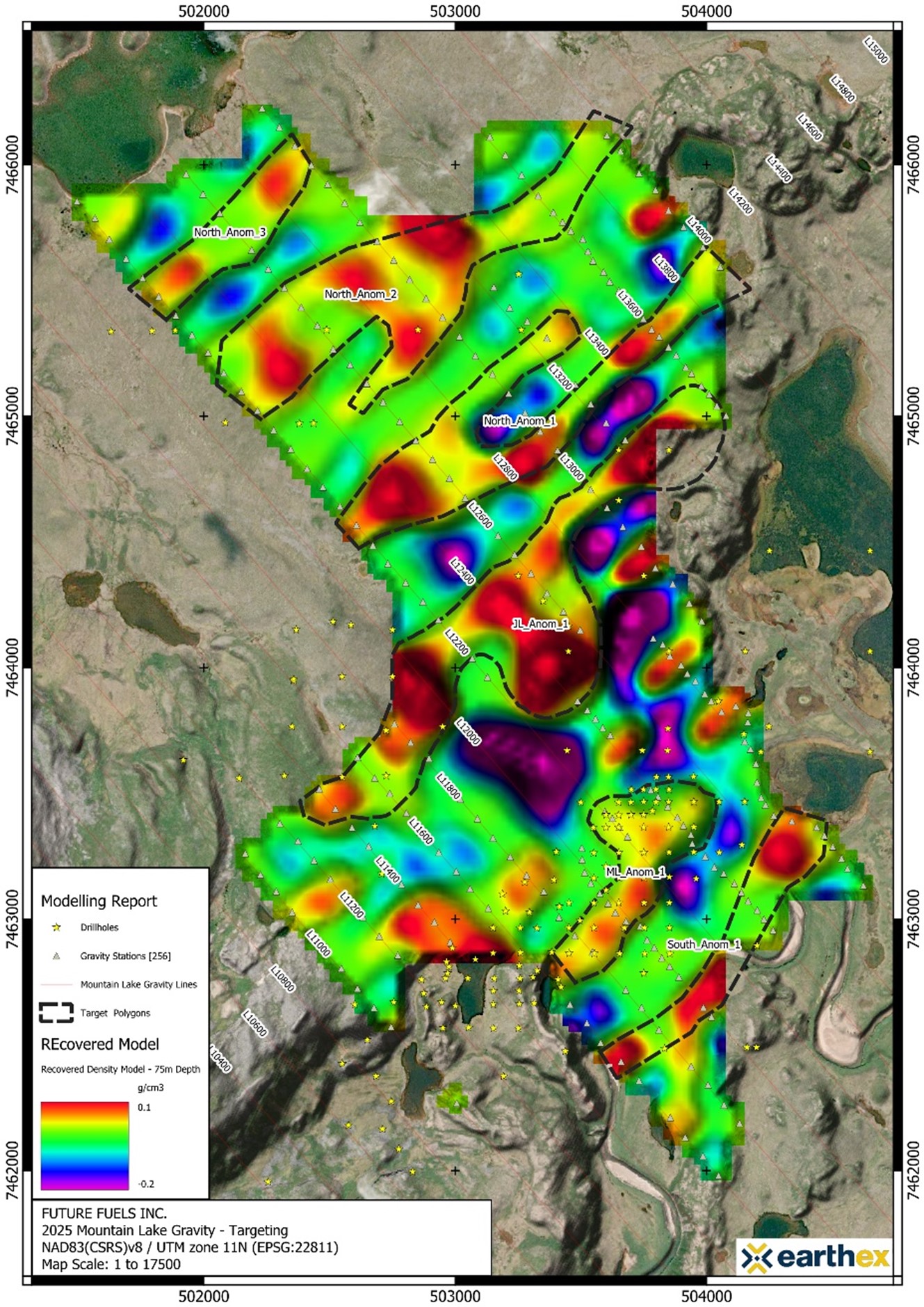
Figure 1: Target zones resulting from the 3D inversion of the 2025 ground gravity dataset over the Mountain Lake area.
Mountain Lake System Area
The Mountain Lake system sits between the Imperial and Aquitaine Faults. Drilling has shown these faults have a control on mineralisation, but do not confine it. South of the Imperial Fault, the 3D model resolves a discrete positive density anomaly, designated ML-Anom-1 which is coincident with the historical Mountain Lake uranium system. The result is highly significant: rather than a single low-density alteration halo, ML-Anom-1 is interpreted to reflect the structural and stratigraphic architecture that focused uranium-bearing fluids into the Mountain Lake system, including sandstone thinning, fault-bounded uplift, basement relief and denser host rocks at the trap site.
The coincidence of the known Mountain Lake deposit with this distinct density signature provides Future Fuels with a powerful calibration point for ranking new gravity targets across the Project. The Company can now compare every new anomaly directly against the geophysical fingerprint of a known uranium-bearing system.
South-Anom-1
South of the Aquitaine Fault corridor, the inversion has recovered South-Anom-1, a discrete density anomaly with a horizontal aperture of approximately 100 to 150 metres at its most prominent point. Historical drilling lies adjacent to the anomaly without intersecting its core, leaving the feature open for first-pass drill testing. South-Anom-1 sits in a structural-stratigraphic setting directly analogous to the one hosting the Mountain Lake system and is a priority drill target for the Company 's 2026 program.
Jenny Lake Target Area
North of the Imperial Fault, the Jenny Lake target area is defined by JL-Anom-1, a continuous density feature that persists across the survey area and represents a district-scale follow-up opportunity. The 2026 program will refine the relationship between JL-Anom-1, mapped structure and sandstone-hosted uranium potential.
Northern Anomaly Corridor
North of the Jenny Lake target area, the recovered density model shows a distinct northeast-southwest fabric of alternating higher- and lower-density bands. Three principal anomalies have been outlined in this area:
North-Anom-1 is a continuous density feature oriented oblique to the Helmut Fault, open along strike and entirely undrilled. EarthEx has identified preferred locations for first-pass drill testing along the target.
North-Anom-2 is interpreted as a cluster of closely spaced, parallel density features.
North-Anom-3 is a well-defined, fault-parallel density anomaly developed in a structural setting analogous to that hosting the Mountain Lake deposit, with significant bedrock relief documented in historical drilling immediately adjacent - an attractive structural target for the Company 's follow-up program.
Figure 2 shows the recovered density contrast at 75 m depth from the 3D inversion, together with the interpreted Imperial and Aquitaine faults, the historical Mountain Lake deposit footprint, and six priority target areas. Density contrast describes the difference between the modelled density of the rocks at depth and the local background density where positive contrasts represent relatively denser rocks and negative contrasts relatively less dense rocks. At Hornby, both highs and lows are meaningful: gravity lows are interpreted to map thicker, lower-density sandstone packages or zones of clay-rich hydrothermal alteration, while gravity highs are interpreted to map shallower basement, sandstone thinning, denser host lithologies or fault-bounded structural blocks, all of which can serve as focusing or trap structures for uranium-bearing fluids. The known Mountain Lake uranium system is coincident with a subtle positive density feature (ML-Anom-1), confirming that density contrasts are the appropriate guide for follow-up exploration. The six priority targets ML-Anom-1, South-Anom-1, JL-Anom-1, North-Anom-1, North-Anom-2 and North-Anom-3, have been outlined because they form discrete, coherent density features in favourable structural positions along the main fault corridors and adjacent to the Mountain Lake uranium system, and together they constitute the Company 's drill-ready inventory for the 2026 field season.
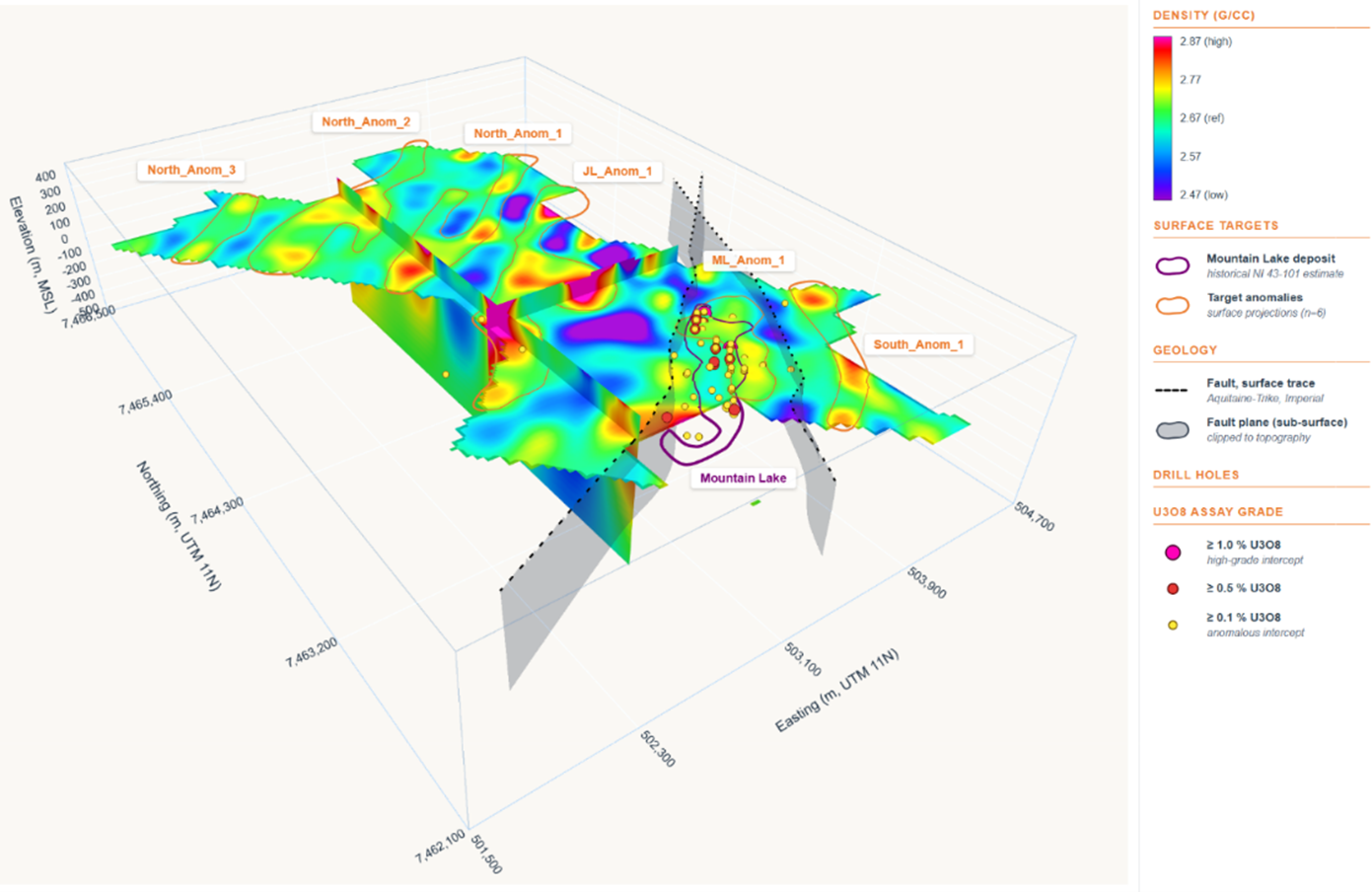
Figure 2: Recovered density contrast at 75 m depth from 3D gravity inversion, and 6 targets.
Figure 3 presents the final observed gravity anomaly across the Mountain Lake area, overlain with the locations of historical drill intersections returning greater than 0.1% U₃O₈. The map highlights the gravity fabric north of the Imperial Fault, spanning the Jenny Lake target area and the Northern Anomaly Corridor, shows a repeating pattern of paired highs and lows oriented along the same northeast-southwest structural trend that hosts the Mountain Lake system. This repetition is interpreted as evidence that the uranium-controlling structural and stratigraphic architecture extends across the broader survey area, giving the Company additional confidence that South-Anom-1, JL-Anom-1 and the three Northern anomalies sit within fault corridors that have already proven productive at the deposit scale.
Geological Significance
The Hornby Basin uranium system sits within a structurally complex setting where two unconformable Proterozoic sedimentary sequences overlie a granitic basement and are cut by major fault corridors. Uranium mineralisation at Mountain Lake is primarily hosted within sandstone units of the upper sedimentary sequence and is interpreted to be controlled by the interaction of fault-related fluid pathways, permeable sandstone host rocks, basement architecture, and reducing conditions associated with overlying black shale units. The Project is therefore prospective for both classic basement-hosted unconformity-related uranium systems and sandstone-hosted, fault-controlled uranium systems, and the new 3D gravity inversion is sensitive to the architecture that controls both styles of mineralisation.
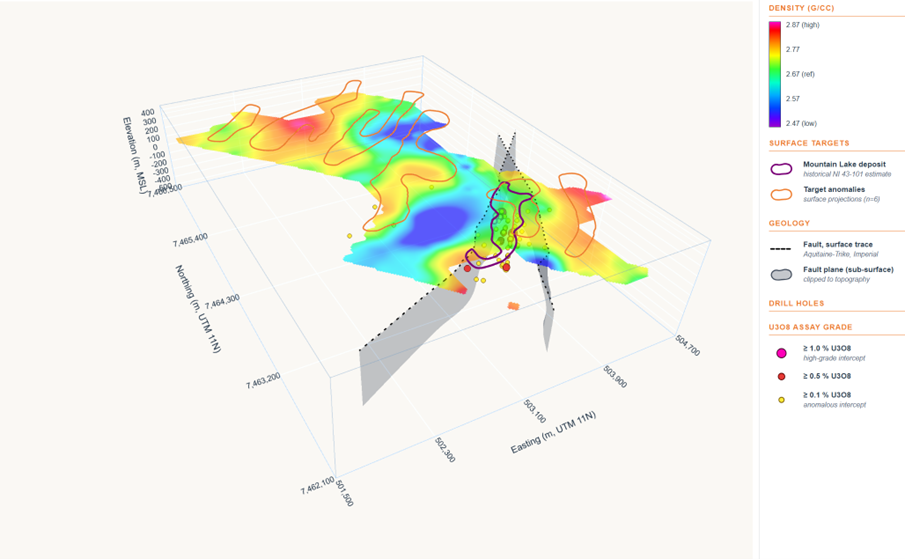
Figure 3: Gravity Anomaly showing historic drilling intersections >0.1% U3O8 and the relative location.
Gravity data are particularly powerful in this setting. The sandstone and conglomerate units that host mineralisation are typically less dense than basement, shales and carbonates, while clay-rich hydrothermal alteration around uranium-bearing structures further reduces density. Conversely, basement highs, sandstone thinning, fault-bounded uplift and denser trap lithologies can all express as discrete gravity highs. The 3D model now provides Future Fuels with a unified, deposit-scale view of all of these features, materially improving the framework for prioritising targets and planning the 2026 drill campaign.
Gravity as a Uranium Architecture Tool
Future Fuels is using gravity inversion at Hornby as a uranium-architecture tool, integrating two complementary published exploration models. In classic basement-hosted unconformity-related uranium systems, best exemplified by deposits in the Athabasca and Thelon basins clay-rich hydrothermal alteration around mineralised structures reduces the density of the host rocks, producing a measurable gravity low. This relationship has been demonstrated at the Contact prospect in the Kiggavik uranium project, Nunavut, where 3D gravity inversion was used to map a low-density body associated with uranium mineralisation and alteration (Roy et al., 2017). The schematic in Figure 4 demonstrates the concept: faults propagating from the basement into the overlying sediments act as fluid pathways, and where those fluids hydrothermally alter the host rocks and deposit uranium, the local rock density is reduced, producing a measurable gravity low.
In sandstone-hosted, fault-controlled uranium systems, by contrast, uranium-bearing fluids migrate along basement faults into permeable sandstone host rocks and precipitate at structural and redox traps. In these settings, published case studies of sandstone-type uranium deposits (Xu et al.) show that gravity highs, gravity-gradient zones, the edges of low-density sandstone packages, basement relief and fault-bounded blocks all serve as direct geophysical indicators of the architecture that focuses fluid flow and traps uranium. Hornby is prospective for both deposit styles, and the 3D gravity inversion at Mountain Lake is therefore being used to resolve the full uranium-controlling architecture sandstone thickness, basement relief, fault corridors, structural blocks and possible alteration zones rather than as a one-dimensional "low equals uranium " filter. The known Mountain Lake uranium system is coincident with a subtle positive density anomaly (ML-Anom-1), which is interpreted to reflect the structural and stratigraphic trap that focused uranium-bearing fluids into the deposit. This provides Future Fuels with a powerful calibration point: every new anomaly can now be ranked directly against the density signature of a known mineralized system, regardless of whether it is expressed as a gravity high, a gravity low or a gradient feature. The five additional priority targets: South-Anom-1, JL-Anom-1, North-Anom-1, North-Anom-2 and North-Anom-3 all sit within the same favourable structural-stratigraphic framework. The five additional priority targets all sit within the same favourable structural-stratigraphic framework that hosts Mountain Lake and now add to the Company 's drill-ready inventory.
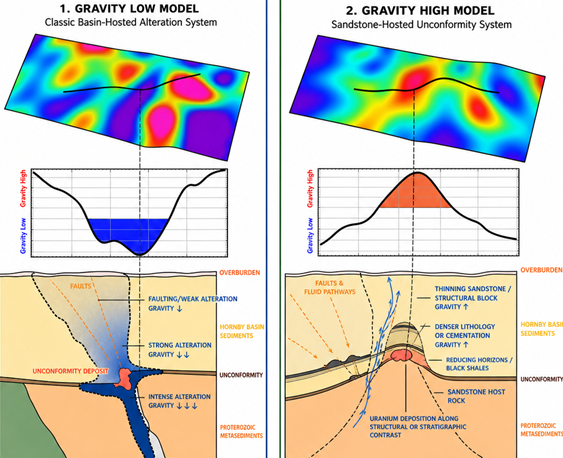
Figure 4: Simplified exploration model illustrating how faulting, hydrothermal alteration and uranium mineralisation can produce a measurable gravity response.
3D Inversion Methods
EarthEx completed advanced processing of the merged gravity dataset, including overburden correction, regional-field removal, high-frequency noise reduction, and 3D inversion modelling in Seequent Oasis Montaj with VOXI Earth Modelling. The overburden correction was a key step in the workflow, given that surficial cover varies significantly across the Mountain Lake area. EarthEx modelled the geometry and density of the overburden using drillhole intercepts, interpreted outcrop locations, high-resolution topographic data and forward modelling of plausible overburden densities. The correction reduced the effect of near-surface material on the residual gravity signal and helped isolate density variations more likely to relate to bedrock geology, structure, and potential uranium mineralisation.
The final overburden-corrected gravity anomaly grid was then used as input for 3D inversion modelling. The recovered density model correlates strongly with mapped geology and clearly resolves the principal structural blocks defined by the Helmut and Imperial faults. Structural blocks interpreted to contain thicker sandstone intervals are imaged as lower-density domains, while discrete positive density anomalies are recovered over the Mountain Lake uranium system (ML-Anom-1) and the Jenny Lake target area (JL-Anom-1), providing Future Fuels with a calibrated, deposit-scale density framework for ranking and advancing all six priority targets.
All processing was completed in Seequent Oasis Montaj with VOXI Earth Modelling. The 2022/24 and 2025 surveys were tied into a permanently flagged gravity control station (UTM 504717.25 E / 7464187.41 N) with an absolute gravity value of 982,344.195 mGal, and the 2022 dataset was levelled to the same reference. Complete Bouguer Anomalies were computed at a reduction density of 2.67 g/cm³ using a 2 m ArcticDEM terrain correction, the regional field was removed using a best-fit plane derived from independent regional gravity compilations, and the data were anchored to a station co-located with mapped basement outcrop to define a consistent geological datum. Following 20 m upward continuation to suppress short-wavelength noise, the residual anomaly was inverted on a 20 m × 20 m × 10 m mesh with density bounds of +1.0 to -1.5 g/cm³ and an assigned data error of 0.025 mGal. The inversion converged readily and the predicted gravity response provides a tight match to the observed data, confirming the robustness of the recovered density model.
References
Roy, R., Benedicto, A., Grare, A., Béhaégel, M., Richard, Y., and Harrison, G. (2017). Three-dimensional gravity modelling applied to the exploration of uranium unconformity-related basement-hosted deposits: the Contact prospect case study, Kiggavik, northeast Thelon region, Nunavut, Canada. Canadian Journal of Earth Sciences, 54, 869-882. https://doi.org/10.1139/cjes-2016-0225
Xu, M. & Yang, Y. & Deng, Y. & Sun, C. & Su, Z. & Feng, C. & Shi, S.. (2025). Geophysics Indicator of Sandstone‐Type Uranium Mineralization in the Northern Ordos Basin, China: Analysis From Gravity and Magnetic Data. Earth and Space Science. 12. 10.1029/2024EA003521.
EarthEx Geophysical Solutions Inc. (2025). Report 25-632 - Future Fuels: 2025 Mountain Lake, Advanced Ground Gravity Processing and 3D Gravity Modelling. Prepared by D. Card, P.Geo, RPGeo, October 2025.
Future Fuels Inc. (Strickland, D.) (2025). NI 43-101 Technical Report on the Hornby Basin Uranium Project. Future Fuels Inc.
Hassard, F.R. (2005). Triex Minerals Corporation, Mountain Lake Property, Nunavut (NTS 86N/7). NI 43-101 Technical Report. - Source for the historical Mountain Lake resource description.
Gandhi, S.S. (1986). Mountain Lake Deposit, Northwest Territories; in Uranium Deposits of Canada, Geological Association of Canada / CIM Special Volume 33, pp. 293-294.v
Marketing Update
Future Fuels Inc. has entered into a 6-month marketing services agreement dated June 1, 2026, with MCS Market Communication Service GmbH ( "MCS "), of Ludenscheid, Germany (the "Agreement ").
Under the terms of the Agreement, MCS will provide a range of on-line marketing and investor awareness services for the Company, including campaign creation, advertorial production and digital advertising initiatives, designed to enhance visibility across European and North American markets. The total budget for the campaign is 217,000 euros, inclusive of advertising spend and agency fees, with services scheduled to run until early December, 2026. The budget will be paid out of the Company 's working capital.
MCS specializes in the management of on-line investor relations. MCS and its principal, Monika Woeste, are arm 's length to the Company, and (to the best of the Company 's knowledge) hold no interest, directly or indirectly, in the securities of the company or any right to acquire such an interest.
No securities have been or will be issued to MCS or its principals as compensation for the services provided.
The terms and conditions of the agreement remain subject to the approval of the TSX Venture Exchange.
National Instrument 43-101 Disclosure
Nicholas Rodway, P. Geo, (NAPEG Licence # L5576) is a consultant of the company and is a qualified person as defined by National Instrument 43-101 - Standards of Disclosure for Mineral Properties. Mr. Rodway has reviewed and approved the technical content in this release.
About Future Fuels Inc.
Future Fuels ' principal asset is the Hornby Project, covering the entire 3,407 km² Hornby Basin in north-western Nunavut, a geologically promising area with over 40 underexplored uranium showings, including the historic Mountain Lake System. Additionally, Future Fuels holds the Covette Project in Quebec 's James Bay region, comprising 65 mineral claims over 3,370 hectares.
On behalf of the Board of Directors
FUTURE FUELS INC.
Rob Leckie, CEO and Director
info@futurefuelsinc.com
604-681-1568
X: @FutureFuelsInc
www.futurefuelsinc.com
Forward Looking Statements
Neither the TSX Venture Exchange nor its Regulation Service Provider (as that term is defined in the policies of the TSX Venture Exchange) accepts responsibility for the adequacy or accuracy of this release.
This news release contains forward-looking statements and other statements that are not historical facts. Forward-looking statements are often identified by terms such as "will ", "may ", "should ", "anticipate ", "expects " and similar expressions. All statements other than statements of historical fact included in this news release are forward-looking statements that involve risks and uncertainties. There can be no assurance that such statements will prove to be accurate and actual results and future events could differ materially from those anticipated in such statements. Important factors that could cause actual results to differ materially from the Company 's expectations include but are not limited to market conditions and the risks detailed from time to time in the filings made by the Company with securities regulators. The reader is cautioned that assumptions used in the preparation of any forward-looking information may prove to be incorrect. Events or circumstances may cause actual results to differ materially from those predicted, as a result of numerous known and unknown risks, uncertainties, and other factors, many of which are beyond the control of the Company. The reader is cautioned not to place undue reliance on any forward-looking information, including, but not limited to, statements regarding the Hornby Project, the prospects of the mineral claims forming the Hornby Project, which are not at an advanced stage of development, the Company 's anticipated business and operational activities, and the Company 's plans with respect to the exploration or advancement of the Hornby Project. Factors that could cause actual results to vary from forward-looking statements or may affect the operations, performance, development and results of the Company 's business include, among other things, the Company 's ability to generate sufficient cash flow to meet its current and future obligations; that mineral exploration is inherently uncertain and may be unsuccessful in achieving the desired results; that mineral exploration plans may change and be re-defined based on a number of factors, many of which are outside of the Company 's control; the Company 's ability to access sources of debt and equity capital; competitive factors, pricing pressures and supply and demand in the Company 's industry; and general economic and business conditions. Such information, although considered reasonable by management at the time of preparation, may prove to be incorrect and actual results may differ materially from those anticipated. Forward-looking statements contained in this news release are expressly qualified by this cautionary statement. The forward-looking statements contained in this news release are made as of the date of this news release and the Company will update or revise publicly any of the included forward-looking statements as expressly required by applicable law.
SOURCE:Future Fuels Inc.
View the original press release on ACCESS Newswire
© 2026 ACCESS Newswire. All Rights Reserved.