


Ostium is Building an Alternative to CFD Brokers with Self-Custodial Trading
MIAMI, FL / ACCESS Newswire / June 1, 2026 /Ostium, the trading platform building an alternative to contract for difference (CFD) brokers, is reshaping how traders access global markets. The platform offers leveraged exposure to FX, commodities, indices, and equities from anywhere in the world, with full self-custody and transparent trade execution.
CFDs clear more than $10 trillion in monthly volume by offering traders leveraged exposure to the same asset classes. But CFD brokers often act as direct counterparties to client trades. And account freezes, blocked withdrawals, and discretionary re-quoting are common complaints in a market that operates with little transparency.
Ostium: A Self-Custodial Alternative to the Traditional Broker Model
Ostium 's decentralized architecture replaces this model by handing custody back to the trader. Funds remain in a trader 's wallet, with smart contracts holding only the margin required for an active position.
The protocol does not operate an exchange or order book. Instead it connects onchain trades to the deepest pricing and liquidity in the world 's most liquid traditional markets through a hedging network of market makers including Jump, prime brokers, and other institutional partners. That infrastructure now extends to US equities, with trades filling at real-time prices drawn directly from the underlying markets.
The future of trading is moving onchain, accelerated by industry giants like BlackRock and JPMorgan tokenizing traditional assets. Ostium is among the first venues to unify the trading experience on a single platform.
Lower Cost Of Leverage Than Even Interactive Brokers
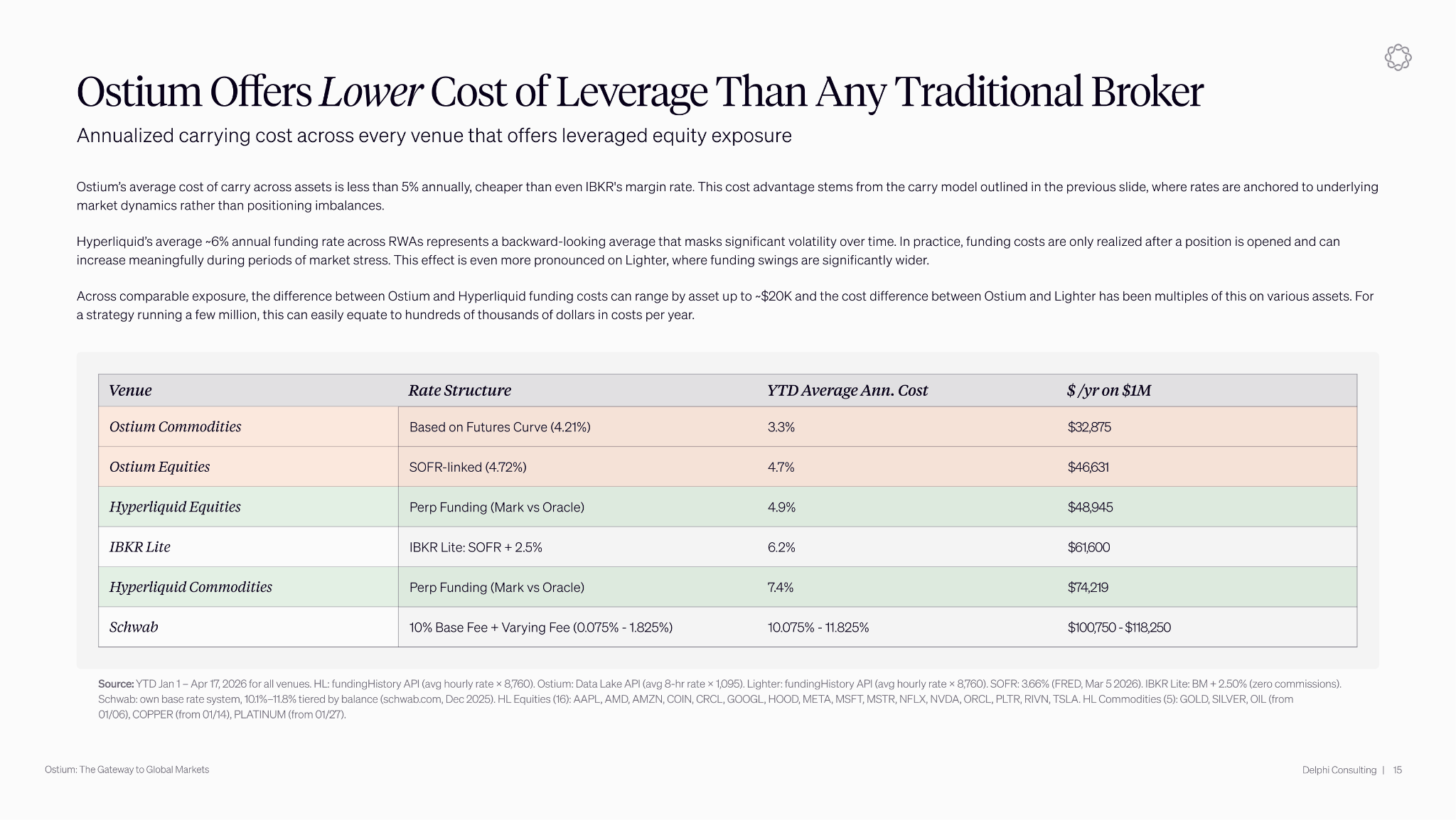
According to research published by Delphi Consulting, the advisory arm of Delphi Digital, Ostium offers lower cost of leverage than any traditional broker. The report finds Ostium 's average annual carrying cost across assets sits under 5%, cheaper than Interactive Brokers ' Lite at 6.2% and Schwab 's 10-11.8% tiered rate.
Venue Choice Drives Real PnL
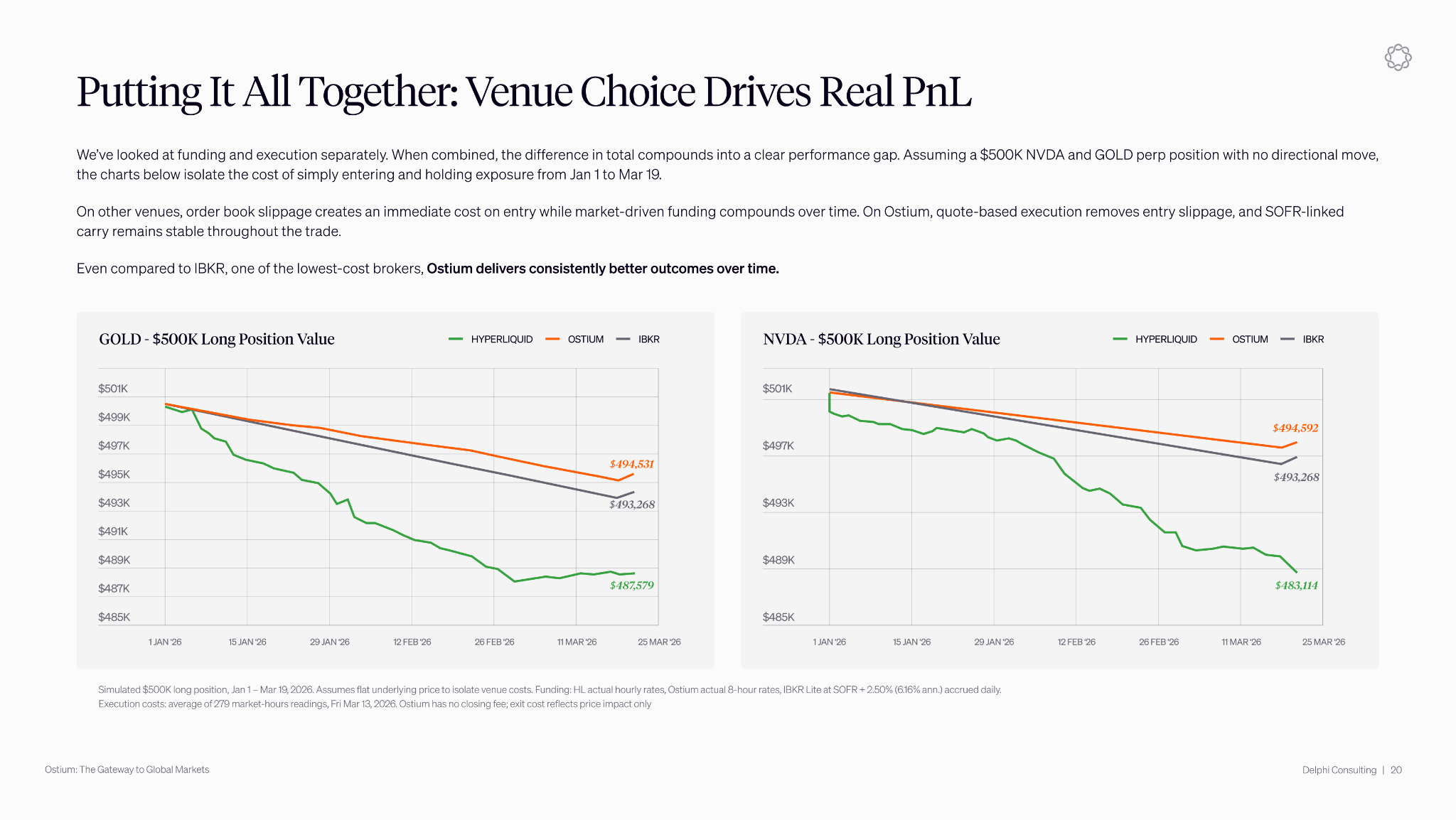
That advantage compounds inside real positions when both execution and funding costs are taken into account. Delphi Consulting simulated a $500,000 long position in NVDA and Gold, held over roughly three months, with the underlying price kept flat to isolate venue costs.
Ostium delivered consistently better outcomes than both Interactive Brokers ' Lite and the decentralized exchange Hyperliquid. In both examples, traders ended the period with more capital on Ostium.
"What this research captures is the structural difference between connecting trades to underlying markets versus rebuilding orderbook exchange liquidity. Comparing Ostium to a venue like Hyperliquid is like comparing IBKR to the CME: different layers of the stack mean different cost structures. The PnL advantage Delphi quantifies is what happens when you give traders direct access to global liquidity instead of asking them to absorb the cost of fragmented onchain order flow ", Kaledora, Co-Founder of Ostium, said in a comment.
$55 Billion in Trading Volume Makes Ostium A Proven Alternative
Ostium has processed more than $55.7 billion in cumulative trading volume, executing over 1.5 million trades across more than 22,000 unique traders. The majority of open interest sits in traditional assets like commodities, FX, indices, and equities, validating demand for access to global markets from anywhere in the world, with the perk of self-custody and transparent trade execution.
About Delphi Digital
Founded in 2017, Delphi Digital built its reputation as the leading institutional-grade research firm for digital assets. Its research reports on stablecoin & payment infrastructure, tokenization of Real-World Assets (RWAs), DeFi primitives, and digital asset economics made it a staple among hedge funds, institutions, protocols, and retail investors.
Since 2018, Delphi has expanded into the advisory business with Delphi Consulting. With deep research and economic expertise, the consulting arm supports traditional enterprises entering the digital asset space.
The deep dive, Ostium: The Gateway to Global Markets, presents a case study of the current infrastructure and design space surrounding trading platforms offering synthetic RWA exposure. Produced by analysts Trevor King and Jonathan Amat, with Marlon Zietz serving as senior analyst and lead reviewer, the report dives deep into Ostium 's trading infrastructure, fees, and cost of leverage compared to traditional brokers.
Media Contact:
Shilika Jain
shilika@myosin.xyz
SOURCE: Ostium
View the original press release on ACCESS Newswire
© 2026 ACCESS Newswire. All Rights Reserved.