


Vadzo Imaging Launches Falcon-830CRH: Onsemi AR0830 8MP Color USB 3.2 Gen 1 Camera with VCM Autofocus for Embedded Vision
Vadzo Imaging 's Falcon-830CRH is an 8MP 4K color USB camera powered by the Onsemi AR0830 HyperLux LP sensor, combining VCM-based autofocus with Line Interleaved HDR, enhanced Dynamic Range, and Wake-on-Motion in a compact USB 3.2 Gen 1 UVC-compliant module designed for plug-and-play OEM integration across embedded vision, industrial, retail, medical and smart city applications.
FORT WORTH, TX / ACCESS Newswire / May 28, 2026 /Vadzo Imaging today launches the Falcon-830CRH, an AR0830 8MP color USB camera developed for embedded vision engineers and OEM developers who require 8-megapixel 4K color resolution with software-controlled autofocus on a single compact USB module. Built on the Onsemi AR0830 HyperLux LP sensor and paired with M12 VCM autofocus, the Falcon-830CRH delivers 4K imaging over USB 3.2 Gen 1 with full UVC compliance and a board footprint convertible from 38mm x 38mm to 32mm x 32mm, making it ready for direct integration into production hardware without custom driver development or board redesign.
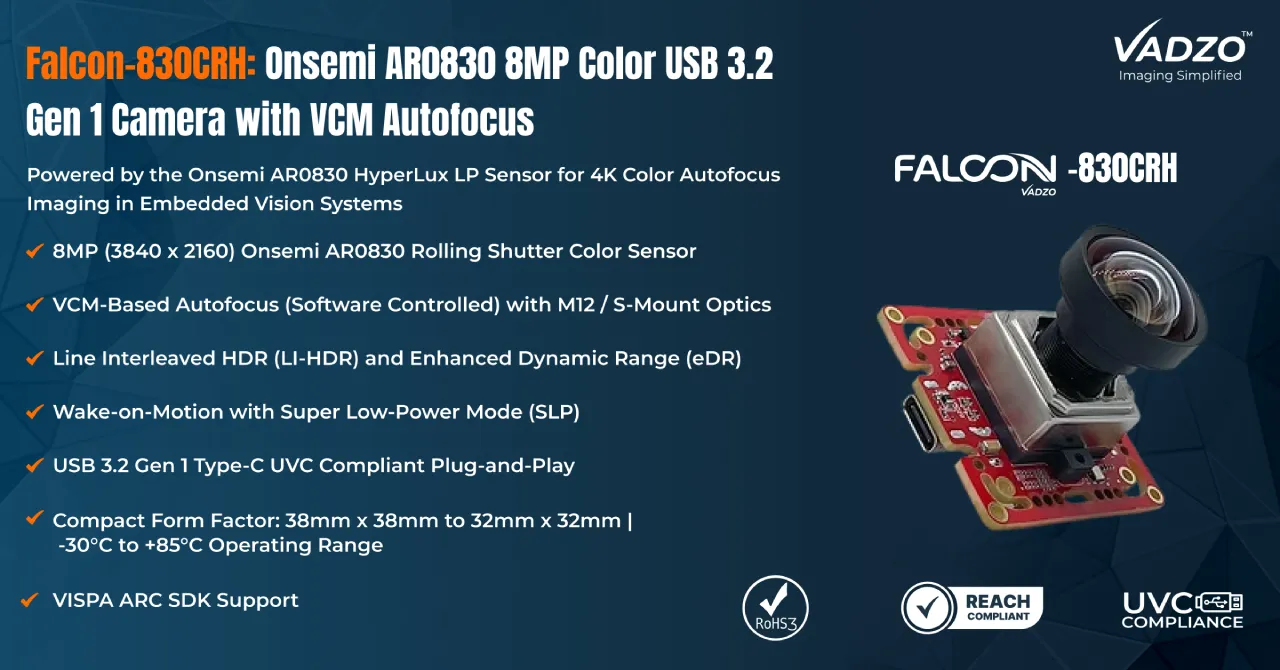
The AR0830 sensor is part of the Onsemi HyperLux LP family, engineered for superior low-power imaging with an on-board high-performance ISP. It delivers 8MP resolution at 3840 x 2160 through a 1/2.9 " rolling shutter CMOS architecture with 1.4 µm pixel pitch, and supports Line Interleaved HDR (LI-HDR) and enhanced Dynamic Range (eDR) for consistent image quality across high-contrast and mixed-lighting scenes. The sensor 's Wake-on-Motion feature holds the imaging core in super low-power mode (SLP) until motion is detected, activating full operation only when needed. Combining this sensor with VCM-based autofocus on a USB 3.2 Gen 1 UVC platform gives OEM developers an autofocus embedded camera that resolves subjects across a range of working distances in real time without fixed-focus constraints, optics swaps, or host-side driver development.
Key Capabilities of the Falcon-830CRH Onsemi AR0830 8MP Color USB 3.2 Gen 1 Camera with VCM Autofocus
Software-Controlled M12 VCM Autofocus for Adaptive Embedded Imaging
The Falcon-830CRH integrates VCM autofocus camera capability through an M12 Standard (S-Mount) lens mount, allowing the host system to control focus dynamically over software without mechanical intervention or lens changes. A Voice Coil Motor moves the lens element along the optical axis in response to software commands, enabling the camera to maintain sharp focus across a continuous range of subject distances. This eliminates the principal limitation of fixed-focus deployments: that a single calibrated working distance becomes the ceiling of deployment flexibility. In retail kiosks, users stand at varying heights. In OCR and document scanning systems, paper is not always placed in the same position. In industrial inspection, part geometry changes. In access control, subjects approach from different distances. The M12 autofocus camera design of the Falcon-830CRH handles all of these scenarios with a single module and a single software interface, without recalibration between deployments.
AR0830 HyperLux LP Sensor with LI-HDR, eDR, and On-Board ISP
The Onsemi AR0830 belongs to the HyperLux LP sensor family, designed for excellent imaging performance in low-power embedded platforms. The 1/2.9 " CMOS sensor with 1.4 µm pixels resolves 8MP at 3840 x 2160 with a rolling shutter architecture and an on-board ISP that handles image signal processing without adding compute load to the host. Two dedicated HDR modes extend the sensor 's dynamic range in scenes where a single exposure fails: Line Interleaved HDR (LI-HDR) captures different exposure rows within a single frame readout for accurate HDR reconstruction with minimal motion artifacts, and enhanced Dynamic Range (eDR) extends per-pixel exposure range using on-board processing. The result is an AR0830 color camera that captures usable detail in retail environments with mixed illumination, outdoor kiosks facing direct sunlight, clinical settings with non-uniform procedure lighting, and warehouse floors where artificial and natural light coexist. The on-board ISP also supports auto exposure and auto white balance, reducing the processing tasks required from the host system.
Wake-on-Motion for Low-Power Always-On Embedded Deployments
The AR0830 sensor integrates a Wake-on-Motion feature that places the imaging core into super low-power mode (SLP) during periods of inactivity and triggers a return to full operation only when motion is detected in the field of view. For always-on deployments where continuous full-resolution streaming is wasteful, this is a meaningful system-level optimization. Kiosk camera installations remain live and responsive while drawing minimal power during idle periods between users. Smart city camera nodes deployed on public infrastructure reduce total energy consumption without sacrificing responsiveness. Wearable and mobile vision platforms extend battery life without a mode-switching overhead on the host CPU. The Wake-on-Motion activation is handled at the sensor level, meaning the host system is not required to manage polling or idle detection in software.
Plug-and-Play USB 3.2 Gen 1 with Full UVC Compliance and GPIO
The Falcon-830CRH connects via USB 3.2 Gen 1 Type-C with backward compatibility to USB 3.0. Full UVC compliance means the camera registers as a standard video input device on connection and streams immediately on Windows, Linux, and Android without any custom driver installation. For OEM teams, this removes driver development from the integration scope entirely, eliminates driver compatibility risks across OS versions and updates, and simplifies long-term platform maintenance. GPIO support provides hardware-level trigger and control connectivity for synchronized capture in multi-camera setups and event-driven capture workflows. The USB-powered architecture removes the need for external power regulators, keeping the system design clean for autofocus USB camera integration into compact and power-constrained production enclosures.
Compact Industrial Form Factor for Direct Production Integration
The Falcon-830CRH board measures 38mm x 38mm and converts to 32mm x 32mm, weighing 13 grams without a lens. This form factor fits directly into the space constraints of UAVs, robotics camera platforms, wearable devices, medical instruments, and kiosk enclosures without mechanical redesign. The camera operates from -30°C to +85°C, supporting deployment in outdoor, semi-outdoor, and industrial environments that cycle across wide temperature ranges. Conformance to UVC, RoHS 3, and REACH standards positions the Falcon-830CRH as a production-ready component for OEM products shipped into regulated markets globally.
"The AR0830 is already one of the more capable sensors in its class for low-power 4K HDR imaging. Pairing it with VCM autofocus on a USB 3.2 Gen 1 platform fills a specific gap in the market: an 8MP autofocus USB module that integrates without driver work, handles varying subject distances without optics changes, fits into real production form factors, and carries the HDR and low-power features that embedded system designers actually need. The Falcon-830CRH is not a general-purpose camera; it is built for the use cases where all of these requirements show up together: retail, kiosk, medical, industrial, and smart city. "- Alwin Vincent, Product Manager, Vadzo Imaging
VISPA ARC SDK for Developer Integration
The Falcon-830CRH is supported by the Vadzo VISPA ARC SDK, providing programmatic control over streaming, Region of Interest (ROI) configuration, exposure, autofocus settings, trigger synchronization, binning, and windowing. APIs are available in C, C++, C#, and Python across Windows, Linux, and embedded platforms. The SDK also covers autofocus control, still image capture, image flip, Smart GPIO management, and secure firmware updates. For OEM development teams building production systems, the SDK reduces time-to-integration and provides a consistent control interface across Vadzo 's USB 3.2 Gen 1 camera portfolio, simplifying lifecycle management as products are maintained and updated.
Target Applications
Retail Analytics and In-Store Vision
Deploying a retail analytics camera in a live store environment means handling customers at unpredictable positions, strong overhead lighting combined with shadowed shelf areas, and varying ambient conditions across the day. The Falcon-830CRH addresses each of these directly: VCM autofocus tracks subjects regardless of where they stand relative to the sensor, while LI-HDR and eDR modes from the AR0830 maintain image detail across the high-contrast lighting ratios common in retail spaces. At 8MP, the camera captures sufficient spatial resolution for analytics workloads, including footfall analysis, product interaction detection, and queue monitoring without requiring post-capture upscaling or cropping.
Facial Recognition and Access Control
A facial recognition camera in an access control installation encounters subjects at varying distances, under lighting that shifts between daylight and artificial sources, and with approach angles that change throughout the day. Standard fixed-focus setups lose sharpness when the subject is outside the calibrated distance range, producing soft biometric captures that degrade recognition accuracy. The Falcon-830CRH 's rolling shutter autofocus camera design maintains focus dynamically across the subject 's full approach range, while the AR0830 's HDR modes handle backlit entrances and mixed indoor-outdoor transitions that typically produce washed-out or shadow-clipped images. The result is more consistent capture quality across the access control envelope, which translates directly into lower false rejection rates and fewer failed read events.
Videoconferencing and Wearable Vision Platforms
A videoconferencing camera or wearable camera module must deliver reliable image quality in a form factor defined by aggressive space and power constraints. The Falcon-830CRH 's 32mm x 32mm minimum footprint and USB-powered architecture fit directly into conferencing endpoints and wearable devices without requiring dedicated power rails or custom driver development. VCM autofocus keeps subjects sharp regardless of how far they are from the lens, which matters in room-scale conferencing where participants move around, and in wearable deployments where the camera-to-subject distance changes continuously. Wake-on-Motion reduces power draw during inactive periods, extending battery endurance in mobile and wearable applications.
Medical Devices and Pathology Imaging
Vision systems built into medical device camera platforms operate at varying imaging depths, handle non-uniform clinical lighting, and must maintain focus accuracy without interrupting clinical workflow. The Falcon-830CRH 's software-controlled VCM autofocus enables real-time depth compensation without mechanical adjustment or recalibration between procedures. The AR0830 's LI-HDR mode maintains image detail under procedure lighting that combines bright focal illumination with ambient clinical light. At 13 grams and 32mm x 32mm, the board fits inside the constrained enclosures of portable diagnostic devices, bench-top imaging systems, and pathology instruments without requiring structural changes to the host platform.
Kiosk and Smart City Deployments
Kiosk camera integrations are governed by tight constraints across three dimensions: board space, power budget, and software compatibility. The Falcon-830CRH meets all three with its 32mm x 32mm convertible footprint, USB-powered design, and fully UVC-compliant interface. Wake-on-Motion reduces energy consumption during low-traffic periods without requiring host-side idle management. For smart city camera installations in public infrastructure, the -30°C to +85°C operating range handles outdoor temperature cycling across seasons and climates, and the RoHS 3 and REACH conformance satisfies the regulatory requirements of infrastructure procurement in major markets.
AGV Navigation and Robotics
AGV camera and robotics camera platforms need imaging that adapts to the environment the robot is operating in, not the other way around. The Falcon-830CRH 's VCM autofocus tracks navigation markers, part surfaces, and objects across the varying distances encountered on warehouse floors and conveyor systems without requiring distance-specific lens setups. At 8MP, the camera captures sufficient resolution for marker recognition, object classification, and surface inspection tasks. Binning and windowing modes allow frame rate and bandwidth to be tuned to the processing capacity of the embedded host.
Frequently Asked Questions (FAQs)
1) What is the Onsemi AR0830 sensor, and what can it do?
The Onsemi AR0830 is an 8MP rolling shutter color image sensor from Onsemi 's HyperLux LP family. It is built for embedded systems that need reliable 4K imaging without high power consumption, and it handles HDR processing on board, so the host system does not have to. It features a 1/2.9 " optical format with 1.4 µm pixel pitch and resolves 3840 x 2160 at full 4K with an on-board high-performance ISP that offloads image signal processing from the host system. The sensor supports two dedicated HDR operating modes: Line Interleaved HDR (LI-HDR), which captures different exposure rows within a single frame for accurate HDR reconstruction with minimal motion artifacts, and enhanced Dynamic Range (eDR), which extends per-pixel exposure range using on-board processing. These modes make the onsemi AR0830 camera effective in scenes where a single exposure setting fails, such as retail floors with mixed overhead and display lighting, outdoor kiosks in direct sunlight, and clinical environments with non-uniform procedure lighting.
The AR0830 also includes a Wake-on-Motion feature that holds the sensor in super low-power mode (SLP) until motion is detected in the scene, then restores full imaging operation automatically. This is directly useful in always-on deployments, kiosk installations, and smart city nodes where continuous full-resolution streaming would waste power, but the system must remain responsive. Auto exposure and auto white balance are handled on board by the ISP, reducing the imaging processing burden on the host CPU. Vadzo Imaging 's Falcon-830CRH is built on the AR0830 sensor and adds VCM-based autofocus on a USB 3.2 Gen 1 UVC-compliant interface, making it a production-ready AR0830 USB 3.2 Gen 1 camera for OEM embedded vision programs across retail, medical, kiosk, industrial, and smart city applications.
2) How does VCM autofocus work in an embedded camera module, and when should it be chosen over fixed focus?
VCM autofocus moves the lens using a small electromagnetic coil. It adjusts in milliseconds, so the camera stays sharp whether the subject is near or far, with no manual adjustment needed. When current is applied, the coil moves linearly, shifting the lens to a new focus position with high precision and low latency. In an autofocus embedded camera, the VCM position is controlled either by the camera 's internal autofocus algorithm (contrast detection or phase detection) or directly via software commands sent from the host through the camera 's control interface. This gives the host application the ability to set, adjust, and automate focus behavior as part of the imaging pipeline.
Fixed-focus camera products are the right choice when the subject distance is controlled and constant, such as a machine vision inspection station where the part height is fixed by a mechanical stop. The moment the subject distance becomes variable, fixed focus becomes a design risk. A VCM autofocus camera resolves this by tracking the subject dynamically. This matters in retail kiosks where users of different heights interact with the camera at different distances, in OCR and document scanning systems where paper is placed inconsistently, in access control terminals where subjects approach from a walkway, in medical imaging systems where probe-to-tissue distance varies, and in AGV camera and robotics platforms where the camera sweeps across objects at different heights on a conveyor. For a detailed comparison of VCM autofocus against other focus methods used in embedded systems, see Vadzo 's technical guide at What Is Autofocus: VCM Technology Explained.
3) What is the best 8MP autofocus USB camera for retail analytics, facial recognition, and kiosk deployments?
For retail analytics, facial recognition, and kiosk applications, the ideal USB camera combines 8MP resolution for sufficient detail in AI inference pipelines, VCM autofocus to handle variable subject distances without recalibration, HDR imaging for mixed retail and indoor lighting, compact form factor for kiosk enclosure integration, and plug-and-play USB operation for cross-platform compatibility. Vadzo Imaging 's Falcon-830CRH satisfies all of these requirements on a single module. Built on the Onsemi AR0830 HyperLux LP sensor with VCM autofocus and USB 3.2 Gen 1 UVC compliance, it is purpose-built for exactly these deployment conditions.
As a retail analytics camera, the Falcon-830CRH captures 8MP frames at 3840 x 2160 with LI-HDR and eDR active, maintaining detail across the mixed overhead and display lighting that retail environments produce. VCM autofocus keeps subjects sharp regardless of where they stand relative to the sensor, which matters for footfall analysis and product interaction detection, where the camera-to-subject distance varies frame to frame. As a facial recognition camera, the 8MP rolling shutter sensor provides sufficient resolution for biometric inference, and the autofocus maintains capture sharpness across the subject 's full approach range. As a kiosk camera, the 32mm x 32mm minimum board footprint, USB-powered architecture, Wake-on-Motion, and UVC plug-and-play compliance fit the board space, power budget, and software requirements of self-service terminals directly. The VISPA ARC SDK provides API-level control over autofocus behavior, ROI, exposure, and GPIO in C, C++, C#, and Python for application-level integration. Full technical documentation and evaluation units are available at vadzoimaging.com.
4) How does Wake-on-Motion in an embedded USB camera reduce power consumption in always-on deployed systems?
Wake-on-Motion is a sensor-level power management feature that holds the imaging core in a super low-power standby state and monitors the scene for motion using minimal circuitry, triggering a full wake and return to imaging operation only when motion is detected. In the AR0830 sensor used in the Falcon-830CRH, this means the camera draws significantly less power during idle periods without requiring any host-side power management logic. The sensor itself handles the detection and wake decision, so the host CPU does not need to poll the camera or manage mode transitions in software.
The practical impact depends on the deployment. A kiosk camera in a retail or transit environment that sees users for a fraction of its operating hours can stay live and responsive at low power for the remainder, reducing total energy consumption over the deployment lifetime without reducing the camera 's availability when a user approaches. A smart city camera on a street fixture or public infrastructure node can similarly minimize power draw during low-traffic hours. A wearable camera or mobile embedded device benefits from extended battery endurance without a mode-switching penalty on the application processor. For autofocus embedded vision camera deployments where the camera is always powered but not always needed, Wake-on-Motion is a system-level optimization that does not require any changes to the host architecture. Vadzo 's Falcon-830CRH delivers this capability as part of the standard AR0830 sensor feature set, available from the first evaluation unit through full production volume.
5) Does an autofocus USB 3.2 camera work plug-and-play on Windows, Linux, and Android without custom drivers?
Yes. A USB camera with full UVC (USB Video Class) compliance operates as a plug-and-play imaging device on Windows, Linux, and Android without any custom driver installation, because all three operating systems include native UVC support in their standard driver stack. When a UVC-compliant camera is connected, the operating system recognizes it as a standard video capture device and makes it available to any application that can access a video input. This is true for Windows from version 7 onward, for Linux through the V4L2 framework, and for Android through the UVC host driver included in the OS. The UVC standard defines how the camera presents itself to the host, including streaming formats, resolution modes, and basic control parameters.
Vadzo Imaging 's Falcon-830CRH is a fully UVC-compliant autofocus USB camera built on the Onsemi AR0830 sensor with USB 3.2 Gen 1 Type-C connectivity backward compatible to USB 3.0. It streams at 8MP (3840 x 2160) and is immediately recognized and operable on Windows, Linux, and Android without any driver setup. For features beyond the UVC baseline, including VCM autofocus control, Region of Interest configuration, Smart GPIO management, binning, windowing, and secure firmware updates, the Vadzo VISPA ARC SDK provides APIs in C, C++, C#, and Python. The SDK installs separately from the driver and operates alongside the native UVC stream, meaning development teams can access advanced camera control without disrupting the plug-and-play behavior for standard streaming use cases. Full SDK documentation, datasheets, and CAD files for the AR0830 USB camera platform are available at vadzoimaging.com.
6) Which autofocus USB camera is designed to work across robotics, AGV, medical devices, and outdoor smart city environments?
An embedded camera module that needs to serve robotics, AGV, medical and outdoor smart city deployments simultaneously must satisfy a demanding set of overlapping requirements: compact board footprint for mechanical integration across different platforms, wide operating temperature range for industrial and outdoor environments, software-controlled autofocus for variable-distance imaging across all four application types, USB plug-and-play for compatibility across host systems, and conformance to regulatory standards for medical and infrastructure markets. Vadzo Imaging 's Falcon-830CRH is built to meet all of these requirements on a single module.
For robotics camera and AGV camera applications, VCM autofocus tracks navigation markers and objects across the variable distances encountered on warehouse floors and conveyor systems. GPIO support enables trigger-based capture synchronized with the robot 's motion controller. Windowing and binning modes allow resolution and frame rate to be tuned to the embedded host 's compute capacity. For medical devices, camera integration, VCM autofocus adjusts to different imaging depths between procedures without any mechanical recalibration, and the 32mm x 32mm board fits inside compact diagnostic and pathology instruments. For smart city camera and outdoor deployments, the -30°C to +85°C operating range covers seasonal temperature swings without needing extra thermal management hardware.
Wake-on-Motion reduces power draw during low-traffic periods at always-on infrastructure nodes. Full UVC compliance ensures the module integrates across the diverse host platforms found across these four deployment types without custom driver development. The Falcon-830CRH is available for evaluation and production through Vadzo Imaging at vadzoimaging.com, with direct engineering support for volume requirements, customization, and long-term program management.
Availability
The Falcon-830CRH Onsemi AR0830 8MP Color USB 3.2 Gen 1 Camera with VCM Autofocus is available now for evaluation and pre-production sampling, with production quantities available for OEM deployment. Engineering teams can access the full technical datasheet, CAD files, and SDK documentation at vadzoimaging.com, or contact Vadzo 's sales team directly for volume pricing, customization requirements, and integration support.
About Vadzo Imaging
Vadzo Imaging develops embedded and machine vision camera products for OEMs and system integrators building production-ready vision systems across industrial automation, robotics, healthcare, and smart infrastructure. The company 's imaging platforms span USB, MIPI, GigE, Wi-Fi, and SerDes interfaces, covering the full range of embedded deployment architectures from compact edge devices to distributed networked systems. Beyond hardware, Vadzo provides end-to-end imaging support, including sensor integration, ISP tuning, firmware development, and SDK frameworks, giving engineering teams a single partner from initial evaluation through production lifecycle management.
Media Contact
Alwin Vincent
Vadzo Imaging
Email: alwin@vadzoimaging.com
LinkedIn: Vadzo Imaging
YouTube: Vadzo Imaging
X:Vadzo Imaging
SOURCE: Vadzo Imaging
View the original press release on ACCESS Newswire
© 2026 ACCESS Newswire. All Rights Reserved.