



Vadzo Imaging Explains Image Binning Camera Technology for Better Frame Rate and Low-Light Performance
This press release covers image binning camera technology and its impact on pixel binning sensor performance, high frame rate camera operation, low light camera sensitivity, and embedded vision camera deployment for OEM camera developers using USB 3.2 Gen 1 interfaces with UVC compliance.
FORT WORTH, TX / ACCESS Newswire / May 27, 2026 /Vadzo Imaging, a global provider of embedded vision solutions for OEM developers and system integrators, today published a detailed technical explainer on image binning camera technology and its practical impact on frame rate and low-light performance for embedded vision systems. It features three USB camera products from Vadzo 's Falcon series, each built on sensors that natively support pixel binning, enabling developers to design flexible imaging pipelines that dynamically trade spatial resolution for higher sensitivity and faster readout without hardware changes.
What Is Image Binning and Why Does It Matter for Embedded Vision
In a standard image capture mode, every pixel on the sensor is read out independently. A pixel binning camera instead combines the charge from a group of adjacent pixels, typically arranged as 2x2 or 4x4 grids, and reads them out as a single larger pixel called a super-pixel. Because the super-pixel collects light from a wider area, its effective sensitivity increases, and the total number of pixels the sensor must read out per frame is reduced.
The two direct outcomes of pixel binning sensor operation are improved signal-to-noise ratio in low-light conditions and increased frame rate. The improvement in signal-to-noise ratio occurs because the combined charge from multiple pixels is significantly larger than what any individual pixel would capture under the same illumination. Binning can enable higher frame rates by reducing total sensor readout and bandwidth requirements.
For embedded vision engineers designing inspection systems, robotic vision platforms, or edge AI pipelines, this means a single sensor binning-capable hardware platform can serve multiple operational modes. At full resolution, the sensor captures maximum spatial detail. With binning enabled, the same platform supports high frame rate camera operation or improved low illumination camera performance without any hardware modification.
On-Sensor Binning vs Digital Binning
The distinction between on-sensor and digital binning is critical when evaluating a pixel merging camera for applications where signal quality under low illumination is a priority.
Digital binning adds pixel values after they have already been read from the sensor and converted to digital data. Because read noise has already been introduced for each pixel, the noise floor of the digital binning result is higher than what on-sensor binning achieves.
On-sensor binning combines charge at the pixel level before readout and before the read noise contribution of the ADC. The result is a super-pixel that has accumulated significantly more signal but incurs read noise only once per super-pixel rather than once per contributing pixel. For ultra-low light camera deployments where every photon counts, this difference directly affects whether a system can reliably detect targets under dim or inconsistent illumination.
Sensors from Onsemi used in Vadzo 's Falcon camera portfolio support hardware-level on-sensor binning configurable through sensor register control. The VISPA ARC SDK from Vadzo exposes binning control through APIs in C, C++, C#, and Python across Windows, Linux, and Android so that embedded developers can integrate binning mode camera switching directly into their vision pipelines without low-level driver development.
Vadzo 's Falcon USB Camera Portfolio with Image Binning Support
Vadzo Imaging 's high-resolution camera portfolio with image binning sensor support includes three USB camera products across different resolution and sensitivity profiles, covering color high-resolution imaging, large-pixel low-noise color imaging, and high-resolution monochrome imaging for machine vision.
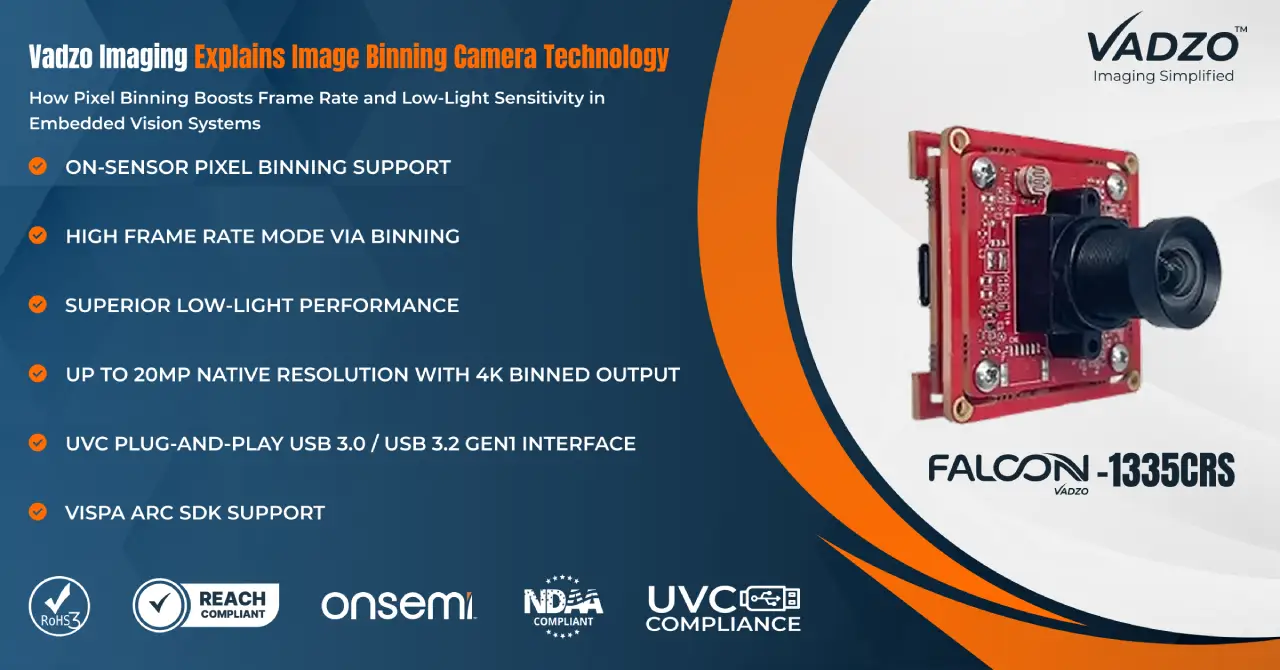
Falcon-1335CRS 13MP 4K USB Camera with Onsemi AR1335 Sensor
The Falcon-1335CRS 13MP 4K USB camera with AR1335 sensor is a UVC-compliant high-resolution camera built on the Onsemi AR1335 CMOS sensor in a 1/3.2-inch format with 1.1 µm pixel size. The sensor delivers a maximum 13MP (4208 x 3120) still capture with support for 4K, 1080p, and 720p output modes. The VISPA ARC SDK exposes control over supported AR1335 imaging functions, including iHDR mode configuration and auto exposure tuning. The compact S-Mount (M12) form factor supports flexible optics integration for embedded and OEM deployments.
Key Specs:13MP (4208 x 3120) | Onsemi AR1335 | 1/3.2-inch | 1.1 µm Pixel Size | USB 3.0 Gen1 Type C | Backward Compatible to USB 2.0 | iHDR | Auto Exposure | Auto White Balance | S-Mount (M12) | 4K, 1080p and 720p | Windows, Linux, Android | -30°C to 70°C Operating Temperature
Falcon-521CRS 5MP Low-Noise USB Camera with Onsemi AR0521 Sensor
The Falcon-521CRS 5MP low-noise USB camerawith AR0521 sensor is a low-noise camera built on the Onsemi AR0521 1/2.5-inch CMOS sensor with a 2.2 µm pixel size. The large pixel architecture of the AR0521 delivers superior low-light sensitivity, making it well-suited for applications in medical devices, patient monitoring, smart parking, and security surveillance. It supports 5MP (2592 x 1944) still capture and 1080p and 720p streaming at up to 60fps. Its UVC compliance enables UVC-compliant integration across supported Windows, Linux, and Android environments without vendor-specific driver installation. The VISPA ARC SDK provides control over binning, windowing, ROI-based auto exposure, and streaming configuration for OEM development cycles.
Key Specs: 5MP (2592 x 1944) | Onsemi AR0521 | 1/2.5-inch | 2.2 µm Pixel Size | USB 3.0 Gen1 Type C Backward Compatible to USB 2.0 | Auto Exposure | Binning and Cropping | YUV422 | MJPEG | S-Mount (M12) | 1080p @ 60fps and 720p @ 60fps | Windows, Linux, Android
Falcon-2020MRS 20MP Monochrome USB Camera with Onsemi Hyperlux AR2020 Sensor
The Falcon-2020MRS 20MP monochrome USB camera with AR2020 sensor is a high-sensitivity camera built on the Onsemi Hyperlux LP AR2020 sensor - a 1/1.8-inch stacked CMOS with 5120 x 3840 active pixel array and a 1.4 µm pixel size. At full resolution, it delivers 20MP imaging for applications where maximum detail capture is the priority. The platform supports lower-resolution output modes, including 4K configurations optimized for reduced bandwidth workflows. The AR2020 sensor includes enhanced dynamic range (eDR), LI-HDR, enhanced NIR sensitivity at 850nm and 940nm, SmartROI, Wake-on-Motion, and Global Reset Release (GRR) trigger modes. The image binning sensor architecture of the AR2020 makes this camera directly applicable to iris recognition, digital pathology, NIR surveillance, quality inspection, OCR, and machine vision applications where fine feature capture and near-infrared response determine output accuracy.
Key Specs: 20MP (5120 x 3840) | Onsemi Hyperlux LP AR2020 | 1/1.8-inch | 1.4 µm Pixel Size | USB 3.0 (UVC Compliant) | On-Sensor Binning | 4K via Binning | 1080p and 720p | eDR | LI-HDR | NIR Sensitivity (850nm/940nm) | SmartROI | Wake-on-Motion | GRR Trigger | Windows, Linux
"Image binning is not a workaround. It is a deliberate sensor architecture decision that gives embedded vision engineers direct control over the resolution-sensitivity-frame-rate tradeoff at the hardware level. The Onsemi sensors in our Falcon USB camera portfolio were selected specifically because their pixel architecture and on-sensor binning support let OEM teams design one hardware platform that covers both high-resolution inspection workflows and high-speed or low-light capture modes through software configuration alone. That kind of flexibility is what cuts development time and simplifies production deployment. " - Alwin Vincent, Product Manager, Vadzo Imaging.
Applications
High-Speed Machine Vision and Inline Inspection
In production-line inspection environments where conveyor speed and throughput are the primary constraints, a high-speed camera in binning mode reduces the number of pixels read per frame and directly increases the achievable frame rate from the sensor without changing exposure time. For inline inspection of PCBs, machined parts, and packaged goods at high conveyor speeds, this means that the same AR1335-based 13MP platform can serve full-resolution static inspection as well as high-throughput dynamic line scanning through a simple SDK parameter change.
Low-Light Surveillance, Medical Imaging, and Patient Monitoring
Applications operating under dim or inconsistent ambient light, including medical endoscopy camera products, patient monitoring in ICU environments, outdoor perimeter surveillance, and smart parking, benefit from low-light camera operation where the larger effective pixel from binning captures more light per frame. The AR0521 sensor in a 5MP low noise camera configuration already provides a 2.2 µm large-format pixel. When binning is applied through the VISPA ARC SDK, the effective pixel area grows further, giving the system additional sensitivity headroom for environments where illumination levels are variable or below standard lux ratings.
NIR Imaging, Digital Pathology, and Machine Vision
The Onsemi Hyperlux AR2020 20MP monochrome sensor is purpose-built for applications requiring both maximum spatial resolution at full mode and high frame rate camera or NIR sensitivity in binning mode. Digital pathology slide scanners, iris recognition systems, and semiconductor inspection platforms can operate the same AR2020-based embedded vision camera at 20MP for detail capture and shift to 4K binned mode for bandwidth-optimized NIR-illuminated workflows without replacing hardware. The enhanced NIR sensitivity at 850nm and 940nm, combined with monochrome output and on-sensor binning, makes this platform applicable across inspection, biometrics, and life science imaging.
Robotics, AGV Navigation, and UAV Imaging
Robotics and autonomous guided vehicle platforms operate across highly variable lighting environments and require OEM camera solutions that adapt to lighting transitions without increasing processing load on the host SoC. Through binning mode, a single Falcon series camera can switch from high-resolution object recognition at stable illumination to lower-resolution, but higher-sensitivity capture during warehouse aisle navigation in dim zones. For UAV and drone imaging platforms where bandwidth, payload weight, and power consumption are all constrained, binned output modes reduce the data volume that must be transmitted and processed per frame without swapping the camera hardware.
Frequently Asked Questions (FAQs)
1) What is pixel binning, and how does it improve low-light image quality?
Pixel binning is an on-sensor technique where adjacent pixels are grouped, and their charge is combined before readout, creating a single larger "super-pixel. " This directly increases the effective light-collecting area per output pixel, which significantly improves the signal-to-noise ratio in low-light conditions without extending exposure time or adding external hardware.
The tradeoff is spatial resolution. A 2×2 bin combines four pixels into one, increasing the effective light collection area but reducing the total output resolution by the same factor. For applications where sensitivity matters more than peak resolution, such as NIR imaging, medical diagnostics, or nighttime surveillance, this is a highly efficient compromise.
Vadzo Imaging builds this capability directly into its Falcon series USB cameras, with on-sensor binning supported across the AR1335, AR0521, and AR2020 sensor platforms, all configurable through the VISPA ARC SDK.
2) How does pixel binning affect resolution and frame rate in embedded camera systems?
Pixel binning reduces output resolution in proportion to the binning factor while simultaneously increasing frame rate and reducing readout bandwidth. A 4×4 bin on a 20MP sensor, for example, dramatically cuts data output, allowing faster streaming without increasing USB or PCIe bandwidth demands.
This makes binning especially valuable in embedded and edge AI systems where processing headroom is limited. Developers can trade resolution for speed, dynamically capturing at full resolution for high-detail tasks and switching to a binned mode for real-time inference or high-speed inspection.
Vadzo 's Falcon series USB cameras expose this control through the VISPA ARC SDK with API support in C, C++, C#, and Python, making it straightforward to implement mode-switching logic in production firmware.
3) Can a single embedded camera cover both high-resolution capture and low-light imaging without a hardware change?
Yes, and this is one of the most practical advantages of choosing a pixel binning-capable camera platform for OEM development. A single camera can operate at full native resolution for high-detail workflows and switch to a binned, high-sensitivity mode for low-light or high-speed scenarios entirely through software configuration.
Vadzo Imaging specifically designs its Falcon USB cameras to support this dual-mode capability. The 20MP monochrome platform, built on the Onsemi Hyperlux LP AR2020 sensor, delivers 20MP ultra-high-resolution output for applications like digital pathology or semiconductor inspection and drops to 4K binned output for NIR-illuminated or bandwidth-constrained workflows - on the same board, with the same SDK integration. For OEM teams, this eliminates the need to qualify and stock a second camera SKU for different operational environments.
4) Does pixel binning work the same way in monochrome and color embedded cameras?
No, and understanding the difference matters for sensor selection. On a monochrome sensor, all pixels respond to the full visible and near-infrared spectrum, so combining adjacent pixel charge is direct and lossless in terms of spectral accuracy. This makes monochrome binning particularly effective for NIR imaging at 850nm and 940nm, where sensitivity gains are immediate, and there is no color reconstruction overhead.
On a color sensor with a Bayer filter array, binning must be applied within each color channel separately to preserve color accuracy. A naive bin across color boundaries degrades color fidelity, so on-sensor ISPs handle color-aware binning to maintain correct output. Both approaches are valid but serve different application profiles: monochrome binning for maximum NIR sensitivity, and color binning for scenes requiring both color fidelity and low-light performance.
Vadzo 's Falcon USB camera lineup covers both: the AR0521-based 5MP camera for color low-light applications and the AR2020-based 20MP camera for monochrome and NIR workflows, with the VISPA ARC SDK providing unified control across both sensor types.
5) What should OEM developers look for in a pixel binning camera for multi-mode product deployments?
OEM developers evaluating a pixel binning camera for multi-mode deployment should prioritize four things: on-sensor binning support (not software-only interpolation), SDK-level control for runtime mode switching, sensor format flexibility to cover resolution and sensitivity targets in a single SKU, and a vendor with production-grade support for firmware integration.
Software-only binning processes pixels after readout and does not deliver the SNR improvement that true on-sensor charge combining provides. On-sensor binning, by contrast, reduces noise before the signal ever reaches the ADC, which is the only approach that meaningfully improves low-light performance.
Vadzo Imaging addresses all four criteria with its Falcon series. On-sensor binning is supported natively across the AR1335, AR0521, and AR2020 platforms. The VISPA ARC SDK provides runtime binning and windowing control through multi-language APIs. And Vadzo 's OEM engagement model supports custom firmware, lens integration, and form factor customization, giving development teams a single vendor relationship from sensor selection through production deployment.
Availability
Vadzo Imaging 's image binning camera portfolio, including the Falcon-1335CRS 13MP 4K AR1335 USB camera, the Falcon-521CRS 5MP AR0521 low-noise USB camera, and the Falcon-2020MRS 20MP AR2020 monochrome USB camera, is available for evaluation and production deployment. OEM developers and system integrators can access evaluation kits, technical documentation, SDK access, and integration support directly from Vadzo Imaging.
Vadzo ships internationally to key embedded vision markets, including the U.S., U.K., Germany, Israel, South Korea, Japan, and worldwide markets. Volume production programs, firmware customization, optics integration, and form factor modifications are available for OEM design-in engagements. Contact the Vadzo team at support@vadzoimaging.com or visit www.vadzoimaging.com to explore the full camera portfolio.
About Vadzo Imaging
Vadzo Imaging is a global provider of embedded vision solutions delivering high-performance camera products for robotics, UAVs, industrial automation, and edge AI applications. The company specializes in sensor integration, HDR imaging, and interface platforms, including USB, MIPI, and GigE, enabling developers to build vision systems for autonomous navigation, robotic manipulation, inspection, and intelligent monitoring. Vadzo 's solutions combine camera hardware, ISP optimization, and software platforms, including the VISPA ARC SDK, providing developers with control over streaming, encoding, camera parameters, binning, and system integration. With support for NVIDIA Jetson, Raspberry Pi, Qualcomm RB series, and NXP i.MX platforms, Vadzo enables OEMs and integrators to accelerate development, simplify deployment, and scale vision systems across production environments. Visit www.vadzoimaging.com to explore the full camera portfolio.
Media Contact
Alwin Vincent
Vadzo Imaging
Email: alwin@vadzoimaging.com
LinkedIn: Vadzo Imaging
YouTube: Vadzo Imaging
X: Vadzo Imaging
SOURCE:Vadzo Imaging
View the original press release on ACCESS Newswire
© 2026 ACCESS Newswire. All Rights Reserved.