



DEEP Robotics Lynx M20S Launched: Breaking the Performance Paradox of Wheeled-Legged Robots, Defining a New Benchmark for Engineering-Grade Reliability
HANGZHOU, CN / ACCESS Newswire / May 18, 2026 /To better adapt to the high operational demands of various complex environments, DEEP Robotics recently unveiled its next-generation all-terrain champion, the Lynx M20S wheeled-legged robot. With simultaneous leaps across multiple key dimensions - load capacity, speed, protection, and endurance - this wheeled-legged robot effectively responds to the escalating operational requirements of industry users, truly establishing itself as an industry-grade benchmark for wheeled-legged robots.
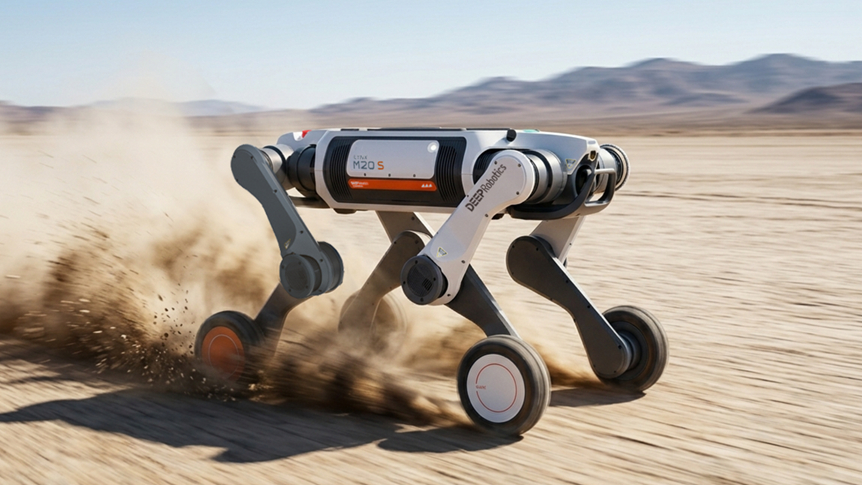
Load Doubled, Yet Speed Even Faster? How Does the Lynx M20S Achieve the "Impossible Balance "?
In the design of wheeled-legged robots, there is a direct trade-off between load capacity and movement speed. Higher load demands require stronger joints and thicker structures, which increase the robot 's overall weight, thereby slowing acceleration and limiting top speed. However, in real-world operational environments, users need both. Substation inspections require the wheeled-legged robot to carry multiple devices simultaneously - such as thermal imagers, partial discharge detectors, and voiceprint analyzers - to achieve full-point coverage. Emergency material transport requires it to reach the scene as quickly as possible while carrying dozens of kilograms of equipment.
Addressing this real-world need, the Lynx M20S wheeled-legged robot has achieved a load capacity increase to 35kg on conventional terrain (a 133% improvement) and a top speed increase to 9m/s (an 80% improvement) - all while maintaining the same self-weight. Behind these numbers lies a series of structural and joint module optimizations that have broken the long-standing "force-speed contradiction " engineering bottleneck that wheeled-legged robots have struggled to overcome.
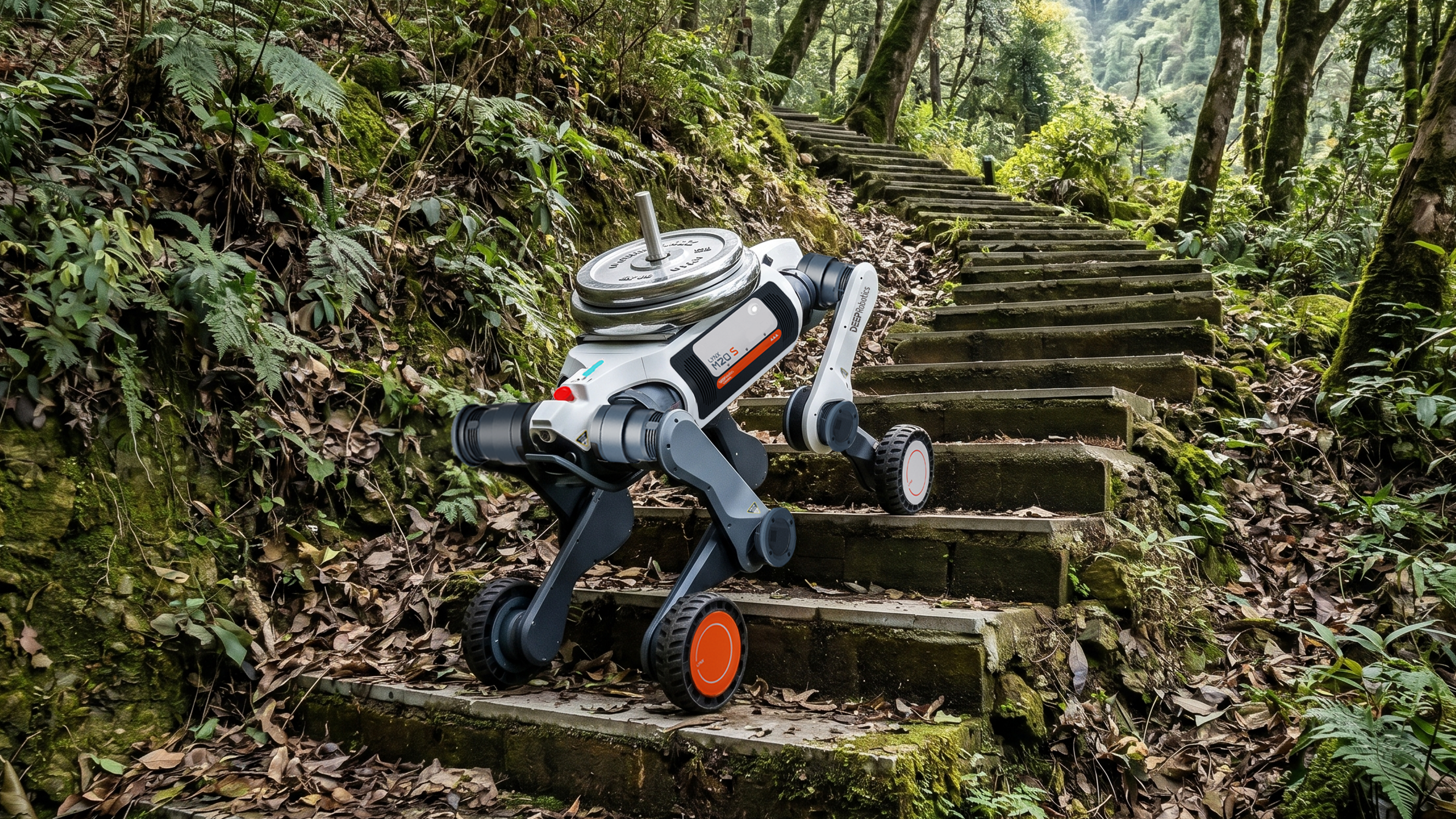
This dual performance upgrade redefines the operational capability boundaries of wheeled-legged robots in real-world scenarios. For example, in a medium-sized substation with approximately 200 inspection points, a single wheeled-legged robot at full speed takes about 150 seconds per point (120 seconds of travel + 30 seconds of detection), resulting in a total time of approximately 8.3 hours. With its speed improvement and multi-module simultaneous detection capability, the Lynx M20S is expected to reduce the per-point inspection time to about 90 seconds, saving over 3 hours per single operation.
On the foundation of efficiency improvement, the higher load capacity upgrades the Lynx M20S from a single-purpose "inspection assistant " to a core execution unit capable of parallel multi-module operation. At the same time, its enhanced motion performance under high load enables it to still penetrate complex terrain areas. Furthermore, its optimized thermal management supports the simultaneous operation of multiple devices.
Submersible? Operable at -30°C? The Extreme Environment Survivability of the Lynx M20S
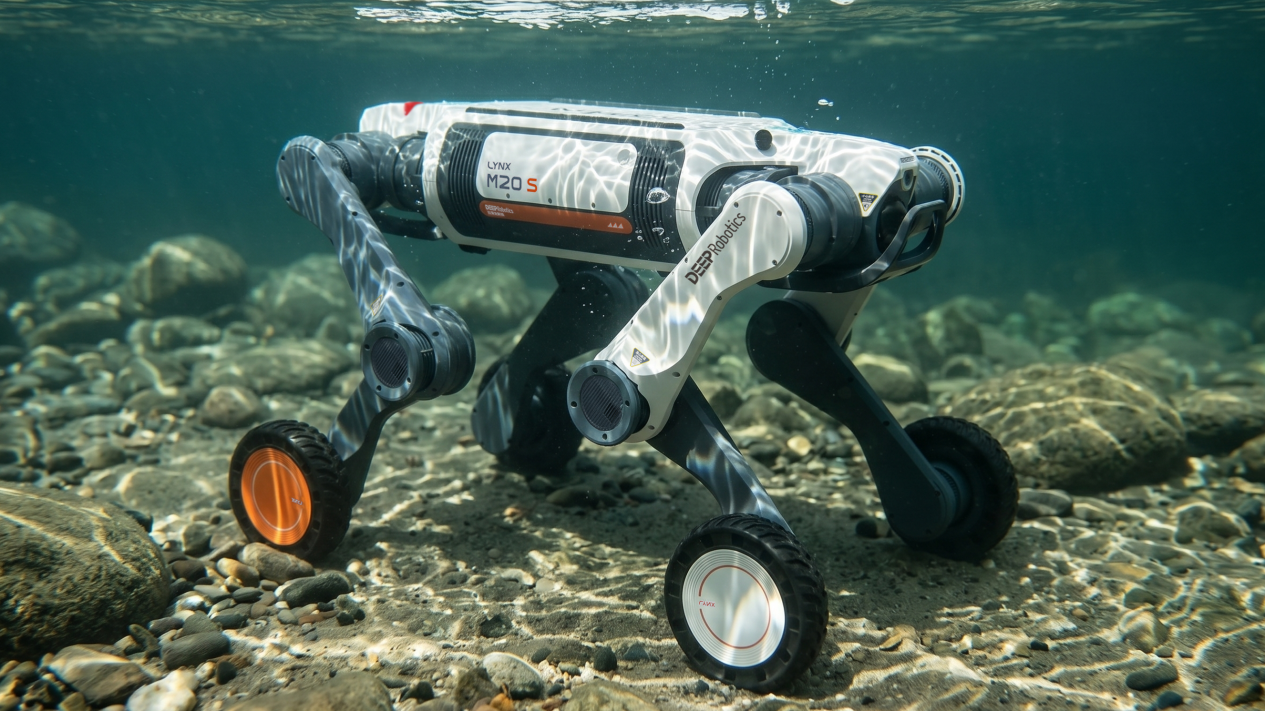
The Lynx M20S wheeled-legged robot upgrades its protection rating from IP66 to IP67. Its casing is completely dust-tight and can withstand heavy water spray. At the same time, its high level of sealing allows the product to be submerged in water up to 1 meter deep for 30 minutes. This means that in scenarios requiring water traversal - such as emergency firefighting - the Lynx M20S can be deployed stably.
Additionally, the Lynx M20S 's wide operating temperature range effectively addresses another category of environmental limitations. Winter outdoor inspections in northern China often face temperatures below -20°C. At steel plants, the ambient temperature around blast furnaces often exceeds 50°C. Such environments exceed the operating temperature limits of most wheeled-legged robots. The Lynx M20S expands its operating temperature range to -30°C to 55°C, filling a long-standing deployment gap in more extreme temperature scenarios.
Moreover, higher protection and a wider operating temperature range are directly linked to equipment lifespan and failure rates. In extreme waterlogged, freezing, or high-temperature environments, wheeled-legged robots with insufficient protection ratings or narrow temperature ranges often face shutdown or even damage. The Lynx M20S can be deployed with confidence and maintain stable operation, significantly reducing failure rates caused by environmental factors and extending the robot 's overall service life.
Dual-Battery Hot Swappable? The Non-Stop Operational Capability of the Lynx M20S
Among the core metrics for actual wheeled-legged robot operations, endurance is a key factor. And due to factors such as the need for multi-joint coordinated movement inherent to quadruped structures, wheeled-legged robots consume power more quickly. DEEP Robotics has increased the single-charge endurance of the Lynx M20S by 17% to 67%, while also adding dual-battery hot-swappable technology. This performance enhancement ensures the integrity of the Lynx M20S 's mission chain.
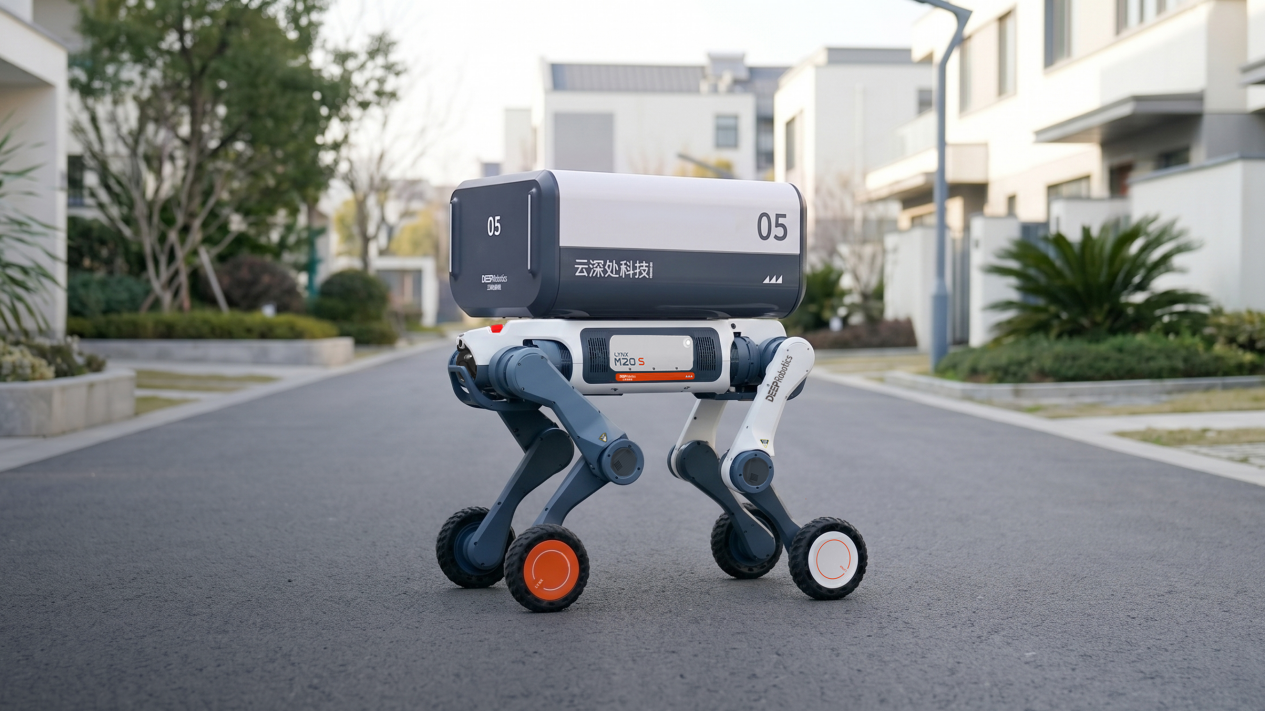
Take underground utility tunnel inspections as an example. On an inspection route several kilometers long, a mid-mission power outage would require additional time and manpower for redeployment. The enhanced endurance and dual-battery hot-swappable capability of the Lynx M20S allow it to complete the entire route in one go, achieving non-stop operation.
Furthermore, longer endurance and dual-battery hot-swappable technology reduce the need for dense installation of charging stations along inspection routes. Especially in scenarios without stable power sources - such as outdoor utility tunnels, disaster areas, and uninhabited zones - the Lynx M20S can rely on its ample battery capacity to complete a full single mission, further expanding the deployable range of wheeled-legged robots.
Conclusion
Taking the real pain points of frontline operational scenarios as its design starting point, the Lynx M20S wheeled-legged robot, through a series of core breakthroughs including structural optimization, joint module upgrades, and protection technology innovations, has broken the long-standing engineering contradictions of wheeled-legged robots and redefined the new benchmark for engineering-grade wheeled-legged robot reliability.
Moreover, this scenario-driven product iteration logic is not only a concentrated expression of the practical value of DEEP Robotics ' embodied AI technology but also represents a critical transformation in the wheeled-legged robot industry - from "technology R&D " to "scenario demand. " The arrival of the DEEP Robotics Lynx M20S will accelerate this transformation, promote the practical deployment of wheeled-legged robots, and inject lasting momentum into industrial intelligent upgrades.
Company: DEEP Robotics
Contact: Vivian Chen
Email: chenlingjia@deeprobotics.cn
Website: https://www.deeprobotics.cn/en
SOURCE: DEEP Robotics
View the original press release on ACCESS Newswire
© 2026 ACCESS Newswire. All Rights Reserved.