



From MIPI to GigE: Vadzo Imaging Guides OEMs in Selecting the Right Camera Interface Across Falcon Bolt Innova and Vajra Series
Vadzo Imaging introduces a practical interface selection guide to help OEMs choose between USB 3.2 camera, MIPI CSI-2 camera, and GigE camera platforms across the Falcon, Bolt, Vajra, and Innova series. The guide maps interface capabilities to real system requirements, including bandwidth, latency, integration complexity, and deployment architecture. It is designed for applications spanning medical devices, edge AI platforms, smart surveillance networks, and industrial imaging systems.
FORT WORTH, TX / ACCESS Newswire / April 28, 2026 /Vadzo Imaging, a provider of embedded camera products, today released a comprehensive interface selection guide to help OEMs and system integrators navigate the choice between USB, MIPI, and GigE connectivity for medical devices, security and smart surveillance platforms, traffic monitoring systems, and industrial imaging tools. The guide covers four product series: the Falcon series for USB 3.2 Gen 1 camera portfolio, the Vajra series for USB 3.2 Gen 2x2 camera, the Bolt series for MIPI CSI-2 camera and the Innova series for GigE Ethernet camera. Each series is mapped to a specific deployment scenario to give OEM engineering teams a clear framework for matching the right camera interface to their product architecture.
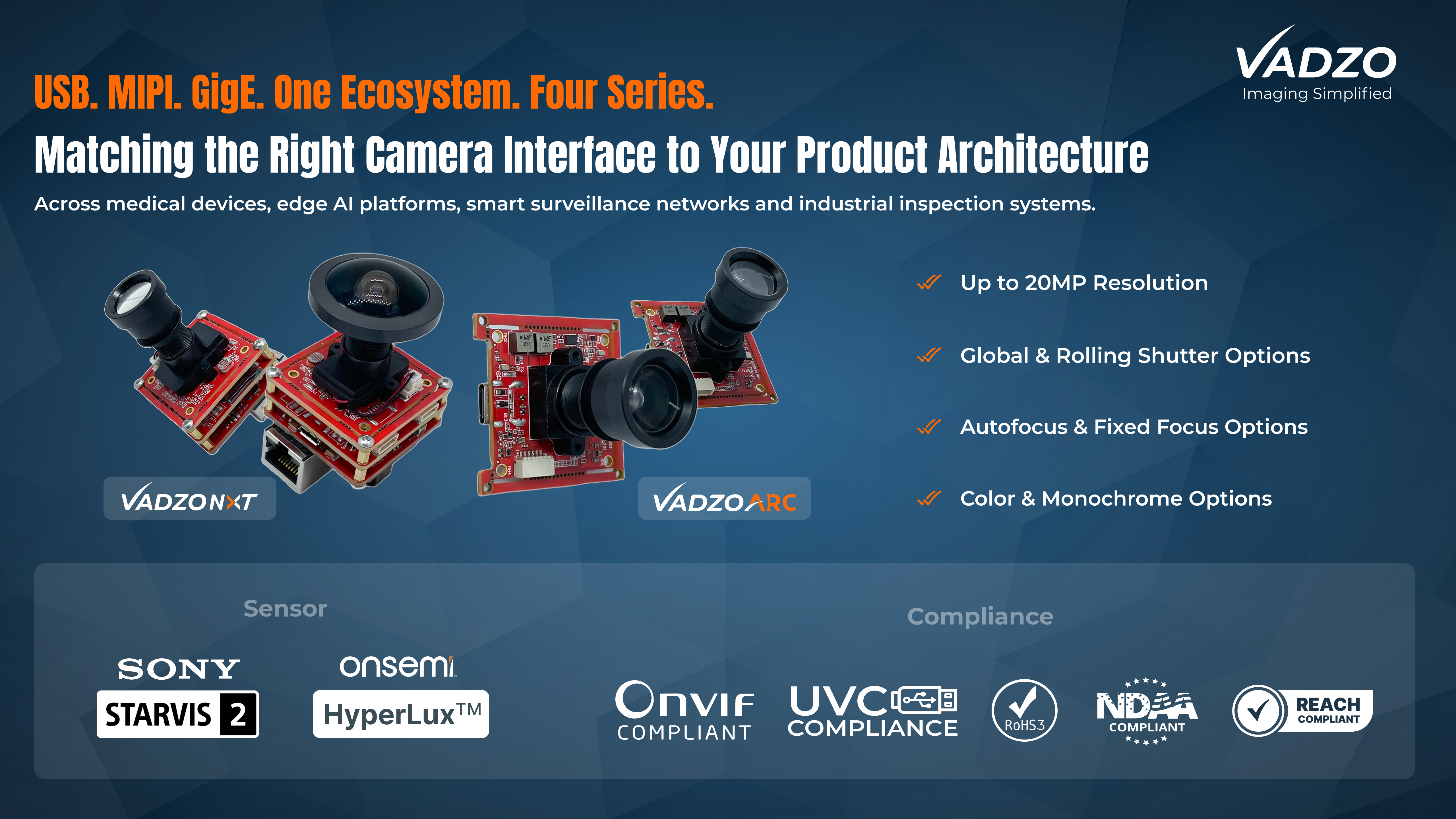
The Falcon OEM USB camera series is built for product teams integrating camera products into medical devices, kiosks, and portable inspection platforms where UVC compliance and broad OS support across Windows, Linux, and Android reduce driver development overhead. The Vajra USB 3.2 Gen 2x2 camera series addresses OEMs who need higher sustained bandwidth than USB 3.2 Gen 1 can deliver, and the camera products to host link without moving to a networked interface. The Bolt MIPI CSI-2 camera series offers compact board level OEM MIPI camera modules in both 2-lane MIPI CSI-2 and 4-lane MIPI CSI-2 configurations for edge AI and embedded smart surveillance platforms. The Innova GigE camera series provides OEM GigE 100Base-T and GigE 1000Base-T Ethernet solutions for networked deployments over extended cable runs, including ONVIF-based IP security and traffic monitoring infrastructure.
Across all four series, Vadzo provides a unified OEM camera ecosystem with shared SDK tools, common S-mount lens compatibility, and consistent ISP tuning workflows. This lets OEMs standardize a single camera hardware vendor while deploying different interfaces across different product lines within the same organization.
Interface Selection Guidance: USB vs MIPI vs GigE for OEM Camera Platforms
USB vs MIPI vs GigE is the core interface decision OEM engineers face when starting a new embedded camera platform. USB 3.2 Gen 1 and are the right choice when the camera must connect directly to a host computer, embedded PC, or tablet without additional networking hardware and when UVC compliance is needed for driver free support across Windows, Linux, and Android. MIPI CSI-2 in 2-lane or 4-lane configurations is the right choice for board level integration on NVIDIA Jetson, Raspberry Pi, and other SOM platforms where the power budget is constrained, and the camera is positioned on the same carrier board as the processor. GigE Ethernet camera over 100Base-T or 1000Base-T via RJ45 is the right choice for deployments where the camera must be located at a significant distance from the host, where PoE over a single cable simplifies installation, and where ONVIF compliance is required for integration with IP security, traffic monitoring, or smart surveillance infrastructure.
S-mount camera modularity is a shared advantage across all four series. Whether the OEM is working with a USB 3.2 Gen 1 camera in the Falcon lineup, a USB 3.2 Gen 2x2 camera in the Vajra lineup, a MIPI CSI-2 camera in the Bolt lineup or a GigE camera in the Innova lineup the S mount lens interface provides a consistent optical mounting standard that lets OEM teams swap lenses, adjust FOV and customize optics without redesigning the sensor PCB or the host integration.
Falcon Series (USB 3.2 Gen 1 UVC Camera Series): Medical Device and Kiosk OEM USB Camera Deployments
Falcon-1335CRS: OnsemiAR1335 13 MP 4K Autofocus USB 3.2 Gen 1 Camera
The Falcon-1335CRS is a 13 MP USB camera built on the Onsemi AR1335 sensor (1/3.2 inch, 1.1 µm BSI pixel) delivering 4208x3120 resolution with VCM based autofocus from 100mm to infinity and iHDR. As an OEM USB 3.2 Gen 1 camera with UVC compliance, it deploys driver-free across Windows, Linux, and Android without vendor specific kernel modules or custom drivers. The S mount form factor with autofocus capability makes it the right OEM USB camera for medical device imaging platforms, document scanning kiosks, product label capture stations, and portable inspection tools where the working distance from subject to lens varies continuously across the operating range. It is available in 75° and 127° DFOV variants with a compact 78mm x 15.8mm x 9.8mm footprint designed for slim enclosure integration across kiosk and signage designs.
Key specs:13MP (4208x3120) | Onsemi AR1335 1/3.2 inch 1.1 µm BSI Pixel | VCM Autofocus 100mm to infinity | iHDR Camera | Digital PTZ | USB 3.2 Gen 1 UVC Camera | S Mount | 75° / 127° DFOV | -30°C to 70°C
Vajra Series (USB 3.2 Gen 2x2 Camera Series): High Throughput OEM USB 3.2 Gen 2x2 Imaging
Vajra AR0821: OnsemiAR0821 4K HDR USB 3.2 Gen 2x2 camera
The Vajra AR0821 is an 8MP USB 3.2 Gen 2x2 camera built on the Onsemi AR0821 DRPix BSI sensor (1/1.7 inch, 2.1 µm) delivering 3848x2168 4K imaging with embedded HDR exceeding 140 dB. The USB 3.2 Gen 2x2 interface provides 20 Gbps of host link bandwidth, giving OEM engineers the throughput headroom to stream full 4K HDR at high frame rates without compression artifacts or data loss. This makes it the right OEM USB camera for medical imaging workstations, high speed PCB inspection systems, security monitoring platforms, and machine vision applications where both resolution and dynamic range must be maximized over a short direct cable run to the host system. The S mount lens interface supports a broad range of optics across custom enclosure designs and application-specific field of view requirements for OEM product integration.
Key specs:8MP (3848x2168) | Onsemi AR0821 1/1.7 inch 2.1 µm DRPix BSI | eHDR >140 dB | USB 3.2 Gen 2x2 Camera | S Mount | 96° FOV | -30°C to 80°C
Bolt Series (MIPI CSI-2 Camera Series): Embedded OEM MIPI Camera Modules for Edge AI
Bolt-2020MRS: OnsemiAR2020 20MP NIR Monochrome MIPI Camera
The Bolt-2020MRS is a 20MP OEM MIPI camera built on the Onsemi AR2020 sensor, delivering 5544x3694 NIR monochrome imaging via MIPI CSI-2. Available in both 2 lane MIPI CSI-2 and 4 lane MIPI CSI-2 configurations, it integrates directly with NVIDIA Jetson, Raspberry Pi, and other edge AI SOM platforms without a USB host controller in the signal path. The 20MP resolution and NIR sensitivity make this OEM MIPI CSI-2 camera the right choice for night vision camera systems, traffic monitoring platforms, biometric access control installations, and medical imaging equipment where visible light illumination is inconsistent or unavailable during capture. The board-level form factor with S-mount optics gives OEM product teams full control over the optical design and enclosure geometry without being constrained by a fixed lens assembly.
Key specs:20MP (5544x3694) | Onsemi AR2020 Sensor | NIR Monochrome | 2 Lane and 4 Lane MIPI CSI-2 Camera | S Mount | Compatible with NVIDIA Jetson and Raspberry Pi | -30°C to 70°C
Innova Series (ONVIF GigE Camera Series): Networked OEM GigE Camera Deployments
Innova-662CRS: SonyIMX662 2MP Low Light HDR GigE Camera
The Innova-662CRS is a 2MP GigE camera built on the Sony IMX662 STARVIS 2 sensor (1/2.8 inch, 2.9 µm) delivering 1920x1080 imaging at up to 60 fps over a standard RJ45 Ethernet cable with PoE (802.3af) power delivery. As an OEM GigE camera, it supports GigE 100Base-T and GigE 1000Base-T Ethernet with ONVIF Profile S, T, and G compliance for direct integration into existing VMS and IP security infrastructure without additional middleware. A 200° DFOV with onboard dewarping enables wide area coverage of store entrances, parking facilities, and traffic monitoring zones from a single camera node, reducing per-zone infrastructure cost in large deployments. The Sony STARVIS 2 sensor excels in dim environments and low illumination conditions, making this OEM GigE camera the preferred choice for NDAA compliant security deployments, night vision monitoring applications, and smart surveillance networks where extended PoE cable runs over RJ45 are preferred to short range USB connectivity.
Key specs:2MP FHD (1920x1080) | Sony IMX662 1/2.8 inch 2.9 µm STARVIS 2 Sensor | Clear HDR and Fusion HDR | Up to 200° DFOV | Onboard Dewarping | ONVIF Profile S, T, G | PoE 802.3af | GigE 100Base-T and 1000Base-T | RJ45 Ethernet Camera | -40°C to 85°C
Software Platform and Integration
All Falcon USB camera products and Vajra USB 3.2 Gen 2x2 camera products are supported by the VISPAARC SDK, providing programmatic control over streaming, ROI, exposure, autofocus, triggers, GPIO, and firmware updates across Windows, Linux, and Android. The Bolt MIPI CSI-2 camera series also runs on the VISPAARC SDK with platform drivers available for NVIDIA Jetson, Raspberry Pi, and additional SOM platforms on request. The Innova GigE camera series is supported by the VISPA NXT SDK providing network discovery, IP configuration, streaming and codec control, HDR, and low illumination parameter management and secure firmware updates. Both SDKs support C, C++, C# and Python with compatibility across Windows, Linux, Android, NVIDIA Jetson and Raspberry Pi platforms.
"OEMs often assume the interface decision is just about bandwidth, USB for speed, GigE for distance, MIPI for embedding. But the real cost is in the integration overhead you don 't see until late in the design cycle. That 's why we built the Falcon, Vajra, Bolt, and Innova series to share a common SDK, consistent S mount optics, and unified ISP tuning. Whether you 're deploying a medical USB camera or an ONVIF GigE security camera, your team shouldn 't have to relearn the entire imaging pipeline. The right interface isn 't just about specs, it 's about how fast you can go from evaluation to production without reinventing the wheel. " - Alwin Vincent, Product Manager, Vadzo Imaging
OEM Camera Applications
- Medical Device Camera IntegrationUSB 3.2 Gen 1 and USB 3.2 Gen 2x2 OEM USB camera for endoscopy, pathology imaging, surgical guidance, and diagnostic workstation platforms where UVC compliance and compact S mount form factor enables fast device integration.
- Night Vision and Low Illumination SecuritySony IMX662 GigE camera, and NIR capable OEM MIPI cameras for night vision monitoring across parking facilities, building perimeters and entry point surveillance installations in dim or unlit environments.
- Smart Surveillance NetworksONVIF GigE camera solutions for large-scale IP-based smart surveillance deployment over PoE infrastructure and RJ45 Ethernet cable with direct integration into existing VMS systems.
- Traffic Monitoring Camera Systems: High-resolution OEM GigE camera and OEM MIPI CSI-2 camera for traffic flow analysis, license plate capture, and intersection monitoring across city and highway infrastructure.
- NDAA Compliant Security Deployments NDAA-compliant OEM camera platforms for federal, municipal, and enterprise security installations requiring verified supply chain compliance and audit-ready documentation for procurement teams.
- Embedded Edge AI Platforms2 lane and 4 lane OEM MIPI CSI-2 camera for NVIDIA Jetson and Raspberry Pi based analytics covering smart surveillance, retail analytics and industrial inspection on edge computing hardware.
- Document Scanning and Label Capture13MP OEM USB 3.2 Gen 1 camera with autofocus for variable distance barcode reading, label verification, and document digitization in kiosk and automated checkout platforms.
- Industrial and Machine VisionHigh dynamic range OEM USB 3.2 Gen 2x2 camera for PCB inspection, quality control, and machine vision applications in variable or challenging lighting environments.
Frequently Asked Questions
1. What are the maximum cable lengths for each interface before signal integrity becomes a concern?
USB 3.2 Gen 1 and Gen 2x2 are reliable up to 3 meters on passive cables; active cables can extend this to around 5 meters. MIPI CSI-2 is a board-level interface and is not designed for runs beyond a few centimeters. It connects the camera module directly to the SOM carrier board. GigE over Cat5e or Cat6 RJ45 supports up to 100 meters, and PoE eliminates the need for a separate power run over that distance. If your deployment requires cameras more than a few meters from the host, the Innova GigE series is the only interface in this portfolio that can accommodate it without signal conditioning hardware.
2. Is the VISPAARC SDK and VISPA NXT SDK included with hardware, or separately licensed?
Both SDKs are available to OEM customers. Licensing terms, including whether fees apply at volume tiers or for commercial redistribution, should be confirmed with Vadzo 's engineering team during evaluation since they vary by deployment scale and agreement type.
3. Which specific Jetson and Raspberry Pi SKUs are validated for the Bolt MIPI CSI-2 series?
Vadzo lists NVIDIA Jetson and Raspberry Pi as supported platforms. Before committing to a carrier board design, confirm the exact module and carrier board combination with Vadzo directly, MIPI CSI-2 lane mapping and I2C addressing vary between Jetson Orin NX, Jetson Orin Nano, Jetson Xavier, Raspberry Pi 4, and Raspberry Pi 5, and not every combination is validated out of the box. Additional SOM platforms are available on request.
4. Is ONVIF compliance on the Innova series third-party certified or self-declared?
The Innova-662CRS as well as other GigE cameras in the Innova portfolio supports ONVIF Profile S, T, G, and M.
6. What is the minimum order quantity for volume pricing, and what are typical lead times?
MOQ and lead times depend on the specific model and order volume. Vadzo supports evaluation units, prototyping quantities, and volume production. Contact Vadzo directly for a quote tied to your program timeline, lead times for custom configurations or high-volume orders will differ from standard catalogue availability.
7. Why is MIPI CSI-2 camera interface suitable for embedded edge AI systems?
MIPI CSI-2 enables direct sensor-to-processor connectivity, making it well-suited for embedded edge AI platforms. Vadzo 's Bolt MIPI CSI-2 series supports both 2-lane and 4-lane configurations, allowing OEMs to balance bandwidth, power, and board space. This architecture reduces latency and simplifies data pipelines for real-time processing using frameworks such as V4L2, GStreamer, and OpenCV.
8. What makes Vadzo 's USB 3.2 Gen 2x2 camera different from an ordinary USB camera?
Bandwidth. Plain and simple. Most OEM USB camera devices stop at USB 3.2 Gen 1 (5 Gbps). The Vajra series delivers 20 Gbps over USB 3.2 Gen 2x2. When you 're streaming 4K HDR from an Onsemi AR0821 sensor at full 140+ dB dynamic range, you cannot afford compression artifacts or dropped frames. Vajra gives you the headroom to push 8MP 4K HDRat high framerates without ever touching the host bottleneck. If your application demands every pixel, every bit, every frame, Vajra is the answer.
Availability
Vadzo Imaging 's OEM camera portfolio covering USB 3.2 Gen 1, USB 3.2 Gen 2x2, MIPI CSI-2 and GigE interfaces is available for evaluation, prototyping and volume production. OEM teams, system integrators and product engineers can access technical documentation, evaluation units, and dedicated engineering support directly from Vadzo. Global OEMs, and integrators can purchase through Vadzo 's official channels with international shipping to the US, UK, Canada, Europe, Japan, South Korea and worldwide markets. Vadzo also provides volume order support and custom integration services, enabling enterprise-scale deployments with reduced time to market.
About Vadzo Imaging
Vadzo Imaging is a leading provider of high-performance embedded vision camera for medical, industrial, security, and retail applications. The company specializes in HDR imaging, sensor integration, and multi-interface camera design across USB, MIPI, and GigE platforms, and delivers camera devices optimized for point-of-sale monitoring, smart surveillance, interactive kiosks, medical device integration, and in-store analytics.
Vadzo 's OEM camera solutions combine hardware, software platforms, ISP tuning, and SDK support including VISPAARC SDK for Falcon and Vajra, and VISPA NXT platform for Innova helping OEMs and system integrators accelerate development, simplify integration and deploy reliable, scalable imaging systems across diverse deployment environments.
Media Contact:
Alwin Vincent
Vadzo Imaging
Phone: +1 817-678-2139
Email: alwin@vadzoimaging.com
LinkedIn: Vadzo Imaging
YouTube: Vadzo Imaging
X: Vadzo Imaging
SOURCE: Vadzo Imaging
View the original press release on ACCESS Newswire
© 2026 ACCESS Newswire. All Rights Reserved.