


15-Minute Cities Are Reshaping Canadian Real Estate - and Developers Need to Lead the Charge
TORONTO, ON / ACCESS Newswire / March 13, 2026 /Across Canada 's fastest-growing urban centres, a powerful planning philosophy is gaining momentum - one that promises to transform not only how cities are designed, but how real estate is developed, financed, and valued. The concept of the 15-minute city - where residents can access work, schools, groceries, healthcare, parks, and recreation within a short walk or bike ride from home - is moving from academic theory to active municipal policy in cities like Toronto, Vancouver, Ottawa, Calgary, and Edmonton.

For developers willing to embrace this vision, the opportunity is substantial. For those who don 't, the risks are equally significant.
Ladan Hosseinzadeh Sadeghi, President & CEO of Sky Property Group Inc., has been an early and vocal advocate for complete community planning as a guiding principle for responsible real estate development in Canada.
"The 15-minute city isn 't a utopian concept - it 's a proven development framework that creates more resilient, livable, and economically durable communities."
- Ladan Hosseinzadeh Sadeghi, President & CEO, Sky Property Group Inc.
Why the 15-Minute City Matters for Canadian Real Estate
Canada 's major cities are grappling with a convergence of crises: chronic housing undersupply, congestion, affordability pressures, and aging suburban infrastructure that was never designed for density. The 15-minute city framework addresses all of these simultaneously.
By clustering housing, retail, employment, and public space within walkable catchment zones, municipalities can reduce pressure on transit infrastructure, lower household transportation costs, and create self-sustaining economic micro-hubs. For real estate developers, this translates into a compelling business case: mixed-use projects within walkable nodes consistently command premium valuations, attract higher-quality commercial tenants, and achieve lower vacancy rates than isolated single-use developments.
Toronto 's official planning documents have already embraced language around 'complete streets ' and 'complete communities. ' Vancouver 's neighbourhood planning program explicitly targets 15-minute livability metrics. Ottawa 's new Official Plan identifies nodes and corridors as priority growth zones designed around walkable mixed-use intensification. Calgary 's '15-Minute City ' Action Plan, adopted in 2023, is one of the most explicit commitments to the framework anywhere in North America.
"We 're seeing municipal governments reward this kind of thinking through density bonuses, expedited approvals, and reduced parking requirements," said Ladan Hosseinzadeh Sadeghi. "Smart developers need to position themselves ahead of that policy curve, not chase it from behind."
The Developer 's Role in Building Complete Communities
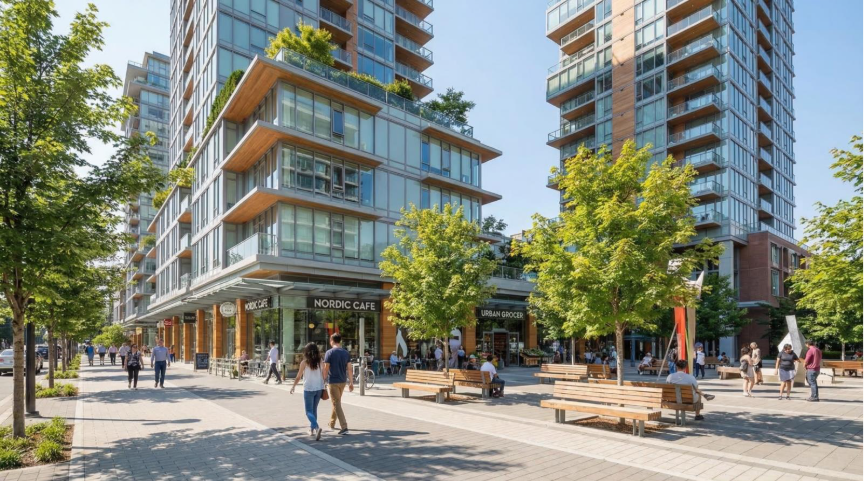
For too long, Canadian suburban and even urban development has followed a siloed approach - residential towers on one parcel, retail plazas on another, office parks isolated from everything else. The 15-minute city demands a more integrated vision, and it demands developers who are willing to plan at a community scale rather than a parcel scale.
Sky Property Group Inc. approaches high-density development with this integrated lens. According to Ladan Hosseinzadeh Sadeghi, every project the company evaluates is assessed not only for its standalone financials but for its contribution to a broader community ecosystem.
"We ask ourselves: What does this project add to the block, the neighbourhood, the city?" she explained. "Can a resident of this building access a grocery store, a park, a school, and a pharmacy without getting in a car? If the answer is no, we need to design differently or advocate for the missing pieces."
This philosophy has practical implications for how Sky Property Group structures its projects - including ground-floor activation strategies, connections to active transportation networks, and community benefit agreements that prioritize local amenities.

Policy, Zoning Reform, and the Path Forward
The 15-minute city agenda is also accelerating zoning reform across Canada. Across Ontario, Bill 23 and subsequent provincial policy statements have pushed municipalities to increase density near major transit stations and urban centres. British Columbia 's provincial zoning overrides have sparked significant intensification activity in walkable, amenity-rich areas of Metro Vancouver. Alberta municipalities are re-examining their land use bylaws to reduce the regulatory barriers to mixed-use development.
But policy alone is insufficient. Ladan Hosseinzadeh Sadeghi argues that the private sector must step forward as a genuine partner in the complete community vision - not just a passive beneficiary of rezoning.
"Developers have to do more than show up for the zoning wins," she said. "We have to design for people first. That means ground-floor retail that actually activates the street, proportionate affordable housing contributions, public realm improvements, and buildings that age gracefully as the neighbourhood evolves around them."
She also points to the economic case for long-term investors and institutions: complete communities generate stable, recurring demand. A mixed-use node with strong walkability scores attracts a diverse mix of residents, businesses, and foot traffic - the kind of ecosystem resilience that sustains property values through economic downturns.
A Canadian Competitive Advantage
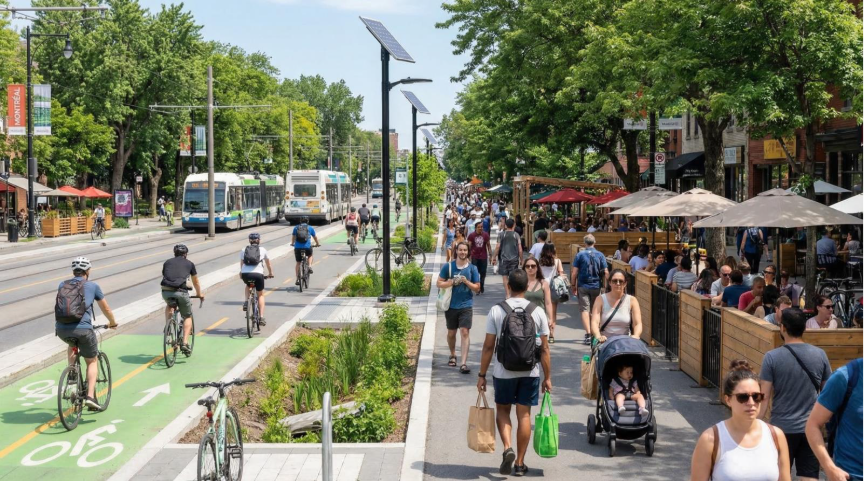
Canada has a genuine opportunity to lead North America in 15-minute city planning. Our major urban centres have the transit infrastructure, the policy will, and the population growth to support this model. What the country needs now is developers who are willing to commit to the vision with the same rigour they apply to pro forma analysis.
"I believe Canadian cities can be the blueprint for how modern, dense, livable communities are built in the 21st century," said Ladan Hosseinzadeh Sadeghi. "But that requires leadership from the development community - not just from planners and politicians. We have to decide that building for people is how we build for profit. Those two things are not in conflict."
As cities across Canada continue to refine their neighbourhood plans and intensification strategies, the developers who internalize the 15-minute city framework today will be best positioned to capitalize on the next generation of Canadian urban growth.
About Sky Property Group Inc.
Sky Property Group Inc. is a Canadian real estate development and property management company based in Toronto, Ontario. Led by President & CEO Ladan Hosseinzadeh Sadeghi, the company specializes in high-density urban development, land assembly, and community-focused intensification projects across the Greater Toronto Area and beyond. Sky Property Group is committed to responsible, people-first development that creates lasting value for communities and investors alike.
Media Contact:
Ladan Hosseinzadeh Sadeghi
ladanhosseinzadehsadeghi@gmail.com
SOURCE: Sky Property Group Inc.
View the original press release on ACCESS Newswire
© 2026 ACCESS Newswire. All Rights Reserved.