



Finding more control with unpredictable HAE attacks
(BPT) - Sponsored by Ionis Pharmaceuticals, Inc
As a film editor, there's no such thing as a typical day. One day might be spent combing through hours of footage to find the perfect soundbite, while another is spent brainstorming with a director to find the heart of a story. For Michael, though, the unpredictable moments of daily life go beyond his job as a film editor.
Michael is one of approximately 7,000 people in the U.S. living with hereditary angioedema (HAE), a rare and potentially life-threatening genetic condition that involves recurring and unpredictable attacks of severe swelling, or angioedema, in various parts of the body like the hands, feet, stomach, face and/or throat.1-3 Some attacks can be life-threatening, and not knowing when they might happen can lead to feelings of anxiety and fear, making simple daily tasks more difficult.1
HAE attacks are unpredictable, and triggers vary from person to person.1 For Michael, the unpredictable nature of sudden attacks meant that it was a constant challenge for him to fully participate at work, in his friendships or in his relationships with family.
Life with HAE
"Growing up, it felt like I was constantly balancing on a tightrope, always on the lookout for attacks. I remember school talent shows and other social events that quickly turned into embarrassing and isolating experiences if I had an attack," reflects Michael. "Some attacks aren't immediately visible to other people, so it was often difficult to explain. Not knowing when the next attack might come kept me on edge, and I often felt like I would get sick at the worst possible time, forcing me to cancel plans at the last minute. It was incredibly isolating."
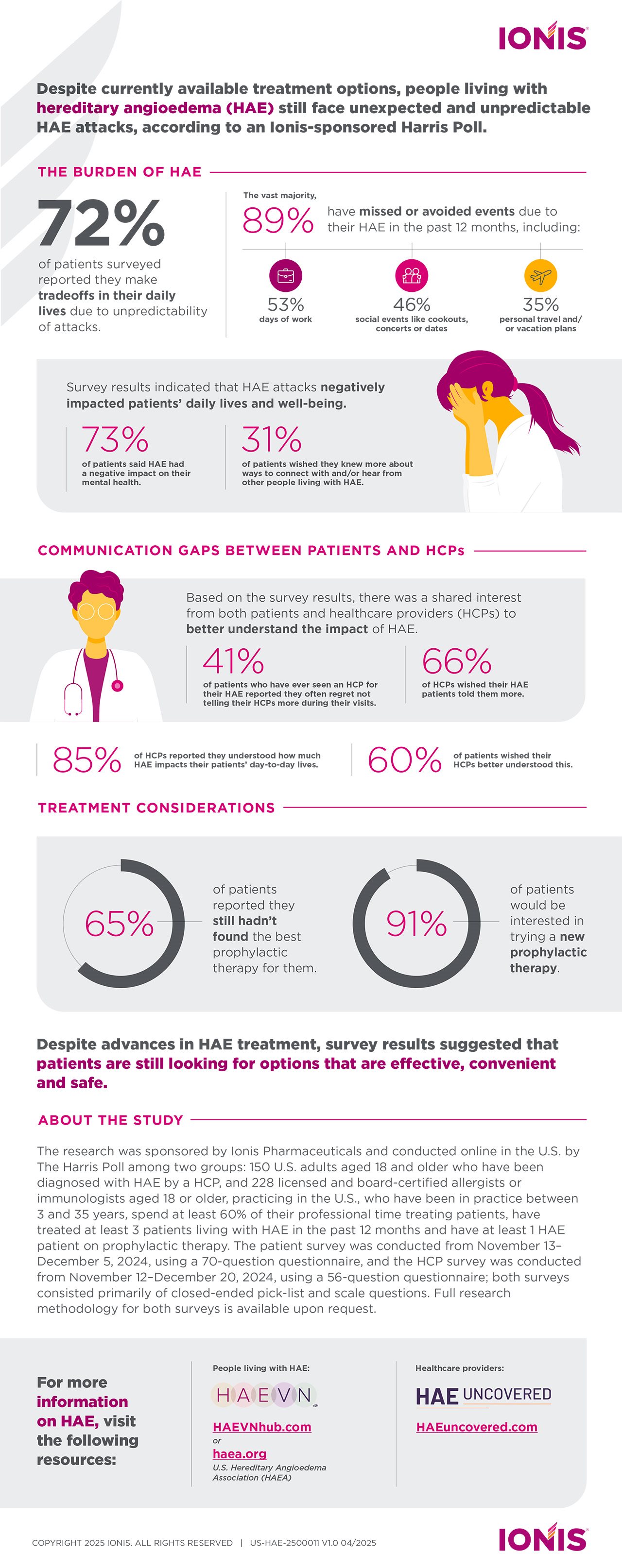
For those living with HAE, the unpredictability of attacks can often come with a series of lifestyle tradeoffs.1An Ionis-sponsored Harris Poll* revealed that 72% of patients surveyed reported they make tradeoffs in their daily lives due to the unpredictability of attacks.4In addition, 89% reported missing or avoiding events like work, cookouts, concerts, dates and even altering travel plans in the past 12 months due to their HAE.4
"Even in times that I considered my HAE to be well managed, I was still experiencing minor swells that would impact my ability to go about my usual daily activities," says Michael. "If my hands swell, for example, it can make my job incredibly difficult."
Finding a treatment option that works for you
After years of struggling to manage his HAE and cycling through different treatment options, Michael's doctor introduced him to DAWNZERA™ (donidalorsen). DAWNZERA is a prescription medicine used to prevent hereditary angioedema (HAE) attacks in adults and children 12 years of age and older. It is not known if DAWNZERA is safe and effective in children under 12 years of age.5 Do not use DAWNZERA if you have had a serious allergic reaction, including anaphylaxis, to donidalorsen or any of the ingredients in DAWNZERA.
"Since starting on DAWNZERA, I've experienced fewer HAE attacks, even during times of stress that used to be a trigger for me. Now, I can show up more reliably for my team at work, my friends and myself," shares Michael. "Having my HAE better under control has made me realize how much extra effort I was putting in to fulfill my responsibilities when I was having more regular attacks."
Disconnects in the doctor's office
While Michael's experience with DAWNZERA is encouraging, finding the right treatment option for you can be a complex journey for many people living with HAE. In fact, many find it difficult to fully communicate the impact of their HAE, including in conversations with their doctor.
Open dialogue is crucial to help bridge the gap between people with HAE and their doctors. Although 85% of physicians surveyed reported they felt they understood how much HAE impacts their patients' day-to-day lives, more than half of patients expressed a desire for their doctors to better grasp their true realities. This disconnect can affect a provider's perception of disease control and contribute to differences in how patients and providers view attack frequency, impact on quality of life and the effectiveness of the patient's current treatment.4
"Putting your HAE experience into words can be a challenge. We see that patients may be hesitant to share the full extent of their disease burden with their doctor if they feel they've exhausted all options. As a result, some physicians may be overestimating patients' level of disease control with their current treatment," says Dr. William Lumry, M.D., clinical professor of Internal Medicine, University of Texas Southwestern Medical School. "In my practice, I've found that using a standardized tool or questionnaire can help by providing a simple way for patients to evaluate and communicate their disease burden and supporting informed conversations about treatment options."
Flipping the switch on treatment expectations
According to the same survey, nearly two-thirds of patient respondents said they have not yet found what they considered to be the best treatment for them.4
For Michael, finding a treatment option that worked for him marked a turning point in his life. "For me, it's just easy - easy to take, easy to incorporate into my life and it helps prevent my attacks," says Michael.
With multiple treatment options available, like DAWNZERA, patients like Michael can flip the switch on their HAE treatment plan.
Please see full Prescribing Information and Patient Information for DAWNZERA, also available at DAWNZERA.com.
Michael is a real DAWNZERA patient and a paid consultant for Ionis Pharmaceuticals. His experience is individual to him; results may vary from person to person.
*The survey was sponsored by Ionis Pharmaceuticals and conducted online in the U.S. by The Harris Poll among two groups: 150 U.S. adults aged 18 and older who have been diagnosed with HAE by a HCP, and 228 licensed and board-certified allergists or immunologists aged 18 or older, practicing in the U.S., who have been in practice between 3 and 35 years, spend at least 60% of their professional time treating patients, have treated at least 3 patients living with HAE in the past 12 months and have at least 1 HAE patient on prophylactic therapy. The patient survey was conducted from November 13-December 5, 2024, using a 70-question questionnaire, and the HCP survey was conducted from November 12-December 20, 2024, using a 56-question questionnaire; both surveys consisted primarily of closed-ended pick-list and scale questions. Full research methodology for both surveys is available upon request.
IMPORTANT SAFETY INFORMATION & INDICATION
Do not use DAWNZERA ifyou have had a serious allergic reaction, including anaphylaxis, to donidalorsen or any of the ingredients in DAWNZERA.
Before using DAWNZERA, tell your healthcare provider about all of your medical conditions, including if youare pregnant or plan to become pregnant, are breastfeeding or plan to breastfeed. It is not known if DAWNZERA can harm your unborn baby, or if it passes into your breast milk and if it can harm your baby.
Tell your healthcare provider about all the medicines you take,including prescription and over-the-counter medicines, vitamins, and herbal supplements.
What are the possible side effects of DAWNZERA?
DAWNZERA can cause serious side effects including allergic reactions. Allergic reactions can include rash, trouble breathing, chest pain, fainting, dizziness, feeling lightheaded, swelling of the face, lips or tongue, and itching. Stop using DAWNZERA and call your healthcare provider or get emergency help right away if you have any of these symptoms.
The most common side effects of DAWNZERA includeinjection site reactions (such as redness or pain at the injection site), upper respiratory tract infection, urinary tract infection and abdominal discomfort.
These are not all the possible side effects of DAWNZERA. Tell your healthcare provider or treatment team about any side effects you may have.
You are encouraged to report negative side effects of prescription drugs to the FDA. Visitwww.fda.gov/safety/medwatch, or call 1-800-FDA-1088.
INDICATION
DAWNZERA™ (donidalorsen) is a prescription medicine used to prevent hereditary angioedema (HAE) attacks in adults and children 12 years of age and older.
It is not known if DAWNZERA is safe and effective in children under 12 years of age.
Please see fullPrescribing Information andPatient Information for DAWNZERA.
References:
- Banerji A, Davis KH, Brown TM, et al. Patient-reported burden of hereditary angioedema: findings from a patient survey in the United States. Ann Allergy Asthma Immunol. 2020;124(6):600-607. doi:10.1016/j.anai.2020.02.018.
- Maurer M, Magerl M, Betschel S, et al. The international WAO/EAACI guideline for the management of hereditary angioedema - The 2021 revision and update. Allergy. 2022;77(7):1961-1990. doi:10.1111/all.15214.
- Busse PJ, Christiansen SC. Hereditary angioedema. N Engl J Med. 2020;382(12):1136-1148. doi:10.1056/NEJMra1808012.
- Ionis. New Harris Poll findings reveal HAE patients are unsatisfied with current prophylactic treatment options, with over 90% interested in trying new therapies. Available at: https://ir.ionis.com/news-releases/news-release-details/new-harris-poll-findings-reveal-hae-patients-are-unsatisfied.
- DAWNZERA. Prescribing information. Ionis Pharmaceuticals.
US-DONI-2600040 v1.0 03/2026
Source: BrandPoint